

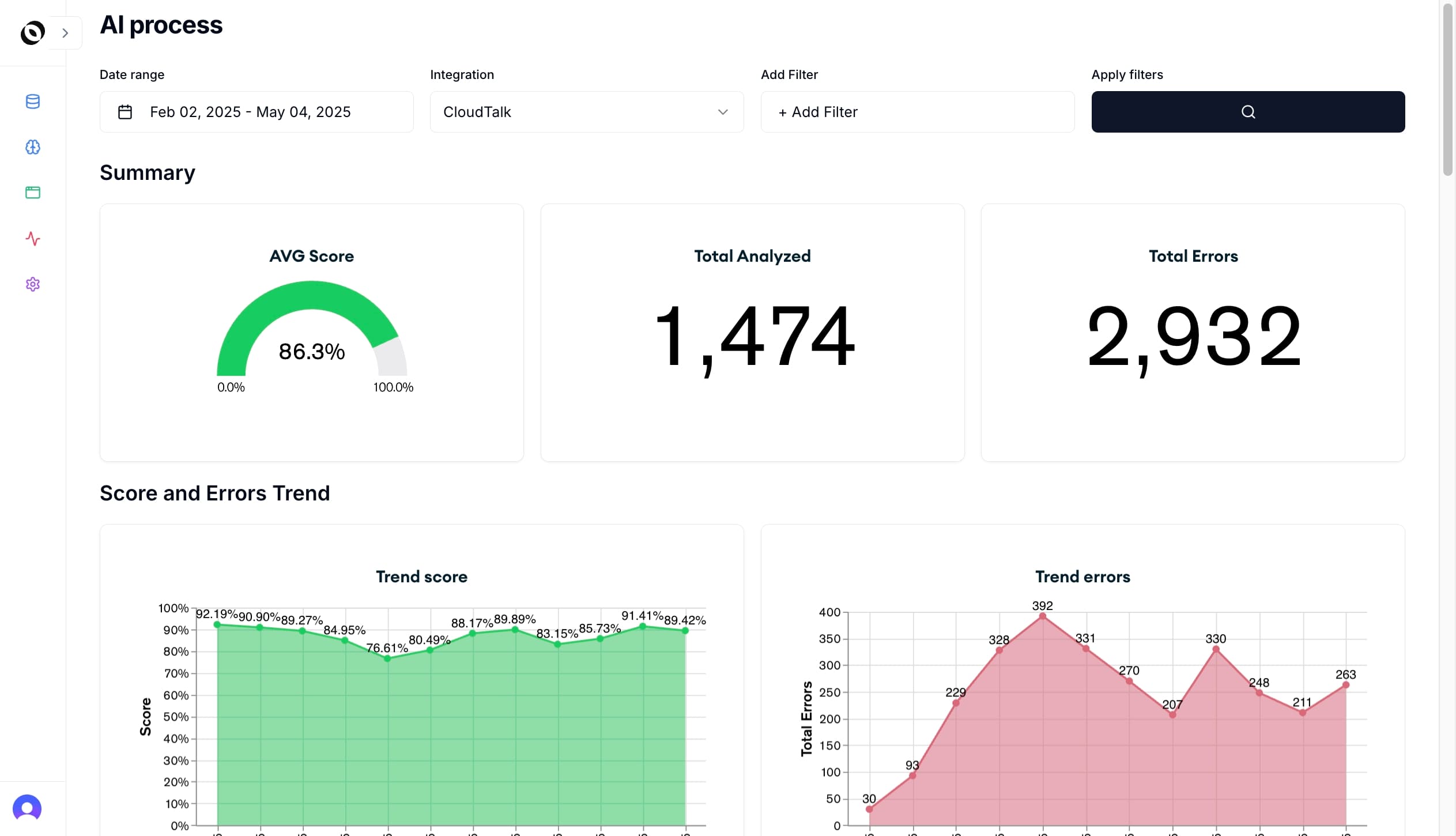
Implementing AutoQA and Voice of Customer at the same time should create one operating system, not two new dashboards.
AutoQA tells you whether an interaction met your quality standard. Voice of Customer tells you what customers needed, felt, and struggled with. Used separately, both programs can produce interesting reports. Used together, they can explain what happened, why it happened, who should act, and whether the action worked.
That distinction matters in 2026. Gartner reports that 91% of service and support leaders are under pressure to implement AI, while customer satisfaction, efficiency, and self-service success remain their top priorities. The same research says leaders expect human roles to expand into areas such as judgment and knowledge management—not disappear behind automation. Gartner: Customer service leaders under pressure to implement AI.
The challenge is no longer whether AI can analyze conversations. The challenge is building a trustworthy operating model around the analysis.
This guide gives CX, QA, support operations, and VoC leaders a practical implementation blueprint.
The Short Answer
To implement AutoQA and VoC together:
- Define the decisions the program must improve.
- Map every interaction source and its data limitations.
- Build a quality scorecard and VoC taxonomy from the same customer journeys.
- Validate AI outputs against a representative human-reviewed set.
- Route each signal to an owner with a response SLA.
- Review quality, customer signal, root cause, and business outcome together.
- Recalibrate whenever policies, products, channels, or AI systems change.
The program is working when a finding reliably produces a decision or action—not when a dashboard has more charts.
Why AutoQA and VoC Belong in the Same Program
Consider a billing interaction that receives a high QA score:
- The agent authenticated the customer.
- The answer matched policy.
- The required steps were documented.
- The interaction closed correctly.
The same interaction may still contain strong negative sentiment because the policy itself is confusing. A QA-only program may conclude that the agent performed well. A survey-only VoC program may conclude that the customer is unhappy. Neither view identifies the full operating problem.
When the signals are connected, the conclusion becomes more useful:
The agent followed policy correctly, but the policy creates avoidable effort and repeat contact. Billing Operations owns the root cause; QA should not coach the agent for it.
This prevents three common mistakes:
- Coaching agents for product, policy, or process defects.
- Treating customer frustration as proof of poor agent behavior.
- Reporting customer themes without assigning the team that can fix them.
The COVER Operating System
Use the COVER loop to design the program:
| Stage | Operating question | Required artifact |
|---|---|---|
| C — Capture | Which customer interactions can we reliably analyze? | Interaction inventory |
| O — Observe | Which quality and customer signals should we extract? | Scorecard and VoC taxonomy |
| V — Validate | Can humans trust the AI-generated findings? | Golden set and calibration log |
| E — Escalate | Who acts on each signal, and by when? | Routing matrix and SLAs |
| R — Review | Did the action improve the customer or business outcome? | Weekly review and outcome log |
The loop is deliberately continuous. New products, policies, agents, prompts, languages, and channels change the operating environment. A model that was accurate last quarter can drift away from the customer experience you need to manage today.
This lifecycle aligns with the govern, map, measure, and manage functions in the NIST AI Risk Management Framework. NIST recommends defining intended use, documenting human oversight, evaluating systems under deployment-like conditions, and monitoring behavior in production. ISO/IEC 42001 similarly uses a continuous Plan-Do-Check-Act model for managing AI systems. ISO: AI management systems.
C — Capture the Interaction Universe
Do not begin with a scorecard. Begin with the interactions.
Create an inventory of every source that shapes the customer experience:
| Source | Typical content | Important context to preserve |
|---|---|---|
| Voice | Calls and IVR journeys | Speaker, timestamps, transfers, hold time |
| Chat | Live chat and messaging | Bot/human handoff, queue, response timing |
| Cases and long-form replies | Thread history, attachments, ownership | |
| Tickets | CRM or help desk records | Status, tags, macros, resolution, reopen |
| WhatsApp/SMS | Asynchronous conversations | Session boundaries, templates, opt-in |
| AI agents | Automated conversations | model/release version, tools, sources, handoff |
| Surveys | Solicited feedback | question, scale, response bias, journey stage |
For each source, document:
- Volume per week and month.
- Languages and markets.
- Available metadata.
- Retention and privacy restrictions.
- Whether the conversation is complete.
- Whether customer and agent identities can be consistently resolved.
- Whether outcomes such as repeat contact, escalation, refund, churn, or renewal can be joined later.
Coverage is not just a percentage
“We analyze 100% of conversations” is incomplete if the program only sees chat, only reads the final message, or cannot distinguish AI from human handling.
Track coverage in four dimensions:
- Channel coverage: which sources are connected.
- Interaction coverage: what share of eligible conversations is analyzed.
- Context coverage: whether the analysis receives the history and metadata it needs.
- Outcome coverage: whether findings can be connected to what happened next.
Use omnichannel AutoQA and VoC when the objective is one quality and customer-signal layer across voice, messaging, tickets, and AI agents.
O — Observe Quality and Customer Signal Together
Build the QA scorecard and VoC taxonomy from the same set of priority journeys.
Start with three to five journeys where better visibility can change an outcome:
- Cancellation or retention.
- Billing and refunds.
- Delivery or fulfillment.
- Onboarding and activation.
- Technical support.
- AI-agent containment and handoff.
For every journey, define four signal families:
| Signal family | Example questions |
|---|---|
| Quality | Was the answer accurate, compliant, clear, and complete? |
| Customer | What did the customer need, say, feel, or repeat? |
| Root cause | Was the failure caused by agent behavior, AI behavior, policy, process, product, or knowledge? |
| Outcome | Was the issue resolved, repeated, escalated, refunded, retained, or lost? |
Use an evaluation contract
Every AI-generated field should have an evaluation contract:
Signal name:
Business purpose:
Definition:
Allowed values:
Evidence required:
Exclusions:
Critical-failure rule:
Human-review trigger:
Owner:
Downstream action:
Example:
Signal name: Resolution quality
Business purpose: Identify unresolved interactions likely to create repeat contact
Definition: The customer received a correct resolution, a committed next step,
or a valid explanation of why the request could not be completed
Allowed values: Resolved / Partially resolved / Unresolved / Not observable
Evidence required: Exact interaction evidence and outcome rationale
Exclusions: Customer abandoned before the issue was stated
Critical-failure rule: Mark critical when the interaction claims resolution
but contradicts policy or creates financial/customer harm
Human-review trigger: Critical failure or low confidence
Owner: QA Operations
Downstream action: Review queue, coaching, or root-cause routing
The “not observable” option is important. Forcing the AI to score missing evidence creates false certainty.
For scorecard design, use the criteria in AutoQA Scorecard Criteria for CX Teams. For taxonomy design, see VoC Taxonomy and Root Cause Analysis.
V — Validate Before You Automate Decisions
AutoQA should not move directly from a demo to performance management.
Build a representative golden set: a collection of real interactions independently reviewed by trained domain experts. It should include normal cases, ambiguous cases, and the failures the business cannot afford to miss.
The set should span:
- High- and low-volume contact reasons.
- Positive, neutral, and negative outcomes.
- Every supported channel and language.
- New and experienced agents.
- Human-only, AI-only, and AI-to-human journeys.
- Policy exceptions and edge cases.
- Compliance, financial, identity, safety, or churn-sensitive contacts.
Do not collapse evaluation into one overall agreement percentage. Measure by criterion and risk:
- Agreement on categorical labels.
- False positives and false negatives.
- Critical-failure recall.
- Evidence quality.
- Human override rate.
- Performance by channel, language, topic, and customer segment.
- “Not observable” usage.
The NIST AI RMF recommends documenting test sets, metrics, limitations, and performance under conditions similar to deployment. It also recommends ongoing production monitoring rather than treating pre-launch testing as permanent proof. NIST AI RMF Core.
Use the companion AutoQA Golden-Set Validation Blueprint for the detailed test design and go-live gates.
E — Escalate Signals to Owners
An insight without an owner is a delayed observation.
Create a routing matrix before launch:
| Signal | Example threshold | Destination | SLA | Expected output |
|---|---|---|---|---|
| Critical compliance failure | Any confirmed event | Compliance + QA | Same day | Decision and remediation |
| AI hallucination | High-risk unsupported answer | AI owner | Same day | Containment or fix |
| Repeat-contact root cause | Sustained increase by topic | Product/Operations | Weekly | Accepted action or rationale |
| Knowledge gap | Repeated inaccurate/incomplete guidance | Knowledge owner | 3 business days | Updated source content |
| Coaching opportunity | Repeated behavior with evidence | Supervisor | Weekly | Coaching action |
| Emerging complaint theme | New theme with material volume | CX/VoC lead | Weekly | Investigation owner |
| Churn signal | Explicit cancellation or competitor mention | Retention/CS | Same day | Outreach or review |
Each route needs:
- A named team and accountable role.
- A threshold that can be audited.
- Evidence attached to the signal.
- A response SLA.
- A closed state and reason.
- An outcome to review later.
Avoid routing every negative interaction. High-volume, low-precision alerts train teams to ignore the system. Prioritize by severity, confidence, customer impact, recurrence, and actionability.
R — Review Outcomes, Not Just Scores
The weekly operating review should connect four layers:
- Signal: What changed?
- Evidence: Which interactions prove it?
- Root cause: What created the pattern?
- Outcome: What decision or action follows?
A useful review statement sounds like this:
Cancellation-policy contacts increased 18% week over week. Resolution quality remained stable, but negative sentiment and repeat contact rose. Evidence points to unclear renewal wording rather than agent behavior. Revenue Operations owns the policy fix by Friday; Knowledge Management will update human and AI guidance after approval.
An unhelpful statement sounds like this:
Sentiment is down and the QA score is 83.
The first statement creates an operating decision. The second creates a dashboard conversation.
Use the Weekly AutoQA + VoC Review Template to run this cadence.
A Practical 90-Day Rollout
Days 1–15: Scope and baseline
- Select three to five priority journeys.
- Inventory interaction sources and privacy constraints.
- Document current manual QA coverage and review cost.
- Define the business outcomes to improve.
- Name the executive sponsor and operating owners.
- Capture baseline QA, repeat contact, escalation, complaint, and sentiment data.
Exit criteria: the team can state what decisions the program will improve and which interactions are in scope.
Days 16–30: Design
- Rewrite scorecard criteria as observable definitions.
- Build the first VoC and root-cause taxonomy.
- Create evaluation contracts.
- Define critical failures.
- Design the golden set.
- Create the routing matrix and review cadence.
Exit criteria: every signal has a definition, evidence rule, owner, and downstream use.
Days 31–60: Validate
- Score the golden set with humans and AI.
- Review disagreement by criterion.
- Test edge cases and missing context.
- Adjust prompts, definitions, and thresholds.
- Validate routing with destination teams.
- Document limitations and accepted residual risk.
Exit criteria: owners trust the evidence enough to use it for limited operational decisions.
Days 61–90: Operate
- Expand coverage in controlled stages.
- Launch human-review queues for high-risk findings.
- Run the weekly AutoQA + VoC review.
- Track alert acceptance and closure.
- Compare findings with repeat contact, complaints, churn, and resolution.
- Create a recalibration trigger for policy, product, model, prompt, or channel changes.
Exit criteria: the program produces a repeatable signal-to-action loop with measurable outcomes.
Metrics That Prove the Program Is Working
Use a balanced set. Do not make “number of conversations analyzed” the primary success metric.
Trust metrics
- Human-to-AI agreement by criterion.
- Critical-failure recall.
- Override and appeal rate.
- Evidence acceptance rate.
- Drift by channel, language, and release.
Operating metrics
- Time from signal to owner.
- Alert acceptance rate.
- Actions closed within SLA.
- Repeated root causes without an owner.
- Time to update a scorecard, prompt, or knowledge source.
Customer and business metrics
- Repeat contact by topic.
- Resolution quality.
- Escalation and complaint rate.
- Customer effort and sentiment movement.
- Retention or churn signal.
- Avoidable-contact volume.
- Cost per reviewed interaction.
The strongest proof is not that the AI produced more labels. It is that teams found important issues sooner, acted with better evidence, and improved a measurable customer or business outcome.
Common Implementation Failure Modes
Automating the old scorecard
Faster scoring does not help if the criteria reward scripts over outcomes. Redesign the standard before scaling it.
Treating sentiment as a verdict
Negative sentiment is a signal, not proof of agent failure. Connect it to issue, journey, root cause, and outcome.
Using one global accuracy number
Overall agreement can hide poor performance on rare critical events. Evaluate by criterion and risk.
Routing everything to QA
QA can validate evidence, but Product, Policy, Operations, Knowledge, Compliance, and AI owners often own the fix.
Launching without an appeal path
Agents, supervisors, and operators need a way to challenge incorrect scores and improve the standard.
Measuring activity instead of change
More dashboards, themes, and alerts do not prove value. Track actions, closure, and outcomes.
Copy-Paste Implementation Checklist
AutoQA + VoC implementation readiness

Purpose
[ ] We named the decisions this program must improve
[ ] We selected priority customer journeys
[ ] We captured baseline customer and operating metrics

Data
[ ] We inventoried every interaction source
[ ] We documented missing context and join limitations
[ ] We approved privacy, retention, and access rules

Evaluation
[ ] Every scorecard criterion has an observable definition
[ ] Every VoC theme has inclusion and exclusion rules
[ ] Every AI output requires interaction evidence
[ ] Critical failures and human-review triggers are defined

Validation
[ ] A representative golden set exists
[ ] Domain experts reviewed it independently
[ ] We measured false positives and false negatives by criterion
[ ] We tested high-risk, multilingual, and edge cases
[ ] Known limitations and residual risks are documented

Operations
[ ] Every signal has an owner and SLA
[ ] Review queues prioritize by risk and confidence
[ ] A weekly cross-functional review is scheduled
[ ] Actions have status, owner, due date, and expected outcome

Continuous improvement
[ ] Appeals and overrides feed calibration
[ ] Production drift is monitored
[ ] Policy, product, model, prompt, and channel changes trigger review
[ ] We measure customer and business outcomes, not only model output
Where Oversai Fits
Oversai AutoQA and Voice of Customer operate on the same interaction layer. CX teams can evaluate human and AI-agent conversations, connect quality scores to topics and sentiment, retain interaction evidence, and route findings into operational workflows.
The goal is not simply 100% scoring. It is a trustworthy system for seeing customer friction, separating frontline behavior from systemic root cause, and helping the right team act.
Frequently Asked Questions
Should AutoQA and VoC use the same taxonomy?
They should share a common customer-journey and root-cause model, but they do not need identical fields. QA criteria evaluate how an interaction was handled. VoC fields classify what customers needed, experienced, and said. The shared model lets teams connect both views.
How long does an AutoQA implementation take?
A controlled pilot can produce useful evidence within 30 to 60 days, but a production operating model usually needs staged validation, routing, governance, and outcome measurement. The 90-day blueprint in this guide is a practical starting point, not a universal deadline.
Can AutoQA scores be used for agent performance immediately?
No. First validate each criterion against representative human-reviewed interactions, document limitations, create an appeal path, and confirm that the evidence is reliable across channels, languages, topics, and agent groups.
What is the difference between AutoQA and conversation analytics?
AutoQA evaluates interactions against defined quality standards. Conversation analytics identifies topics, sentiment, intent, patterns, and other signals. A mature program connects both so quality findings can be understood in customer and business context.
How do you prove ROI from an AutoQA and VoC program?
Connect trusted findings to operating outcomes such as QA review effort, faster issue detection, repeat-contact reduction, complaint prevention, improved coaching, lower compliance exposure, and resolved root causes. Avoid claiming ROI from interaction coverage alone.
What should CX teams implement first: AutoQA or VoC?
Start with the business decisions and journeys that matter most. In many cases, a small shared foundation is better than launching either program in isolation: a focused scorecard, a simple customer-signal taxonomy, a validated interaction set, and one operating review.
Ready to build the operating layer? Explore Oversai AutoQA, Voice of Customer, and CX observability.