

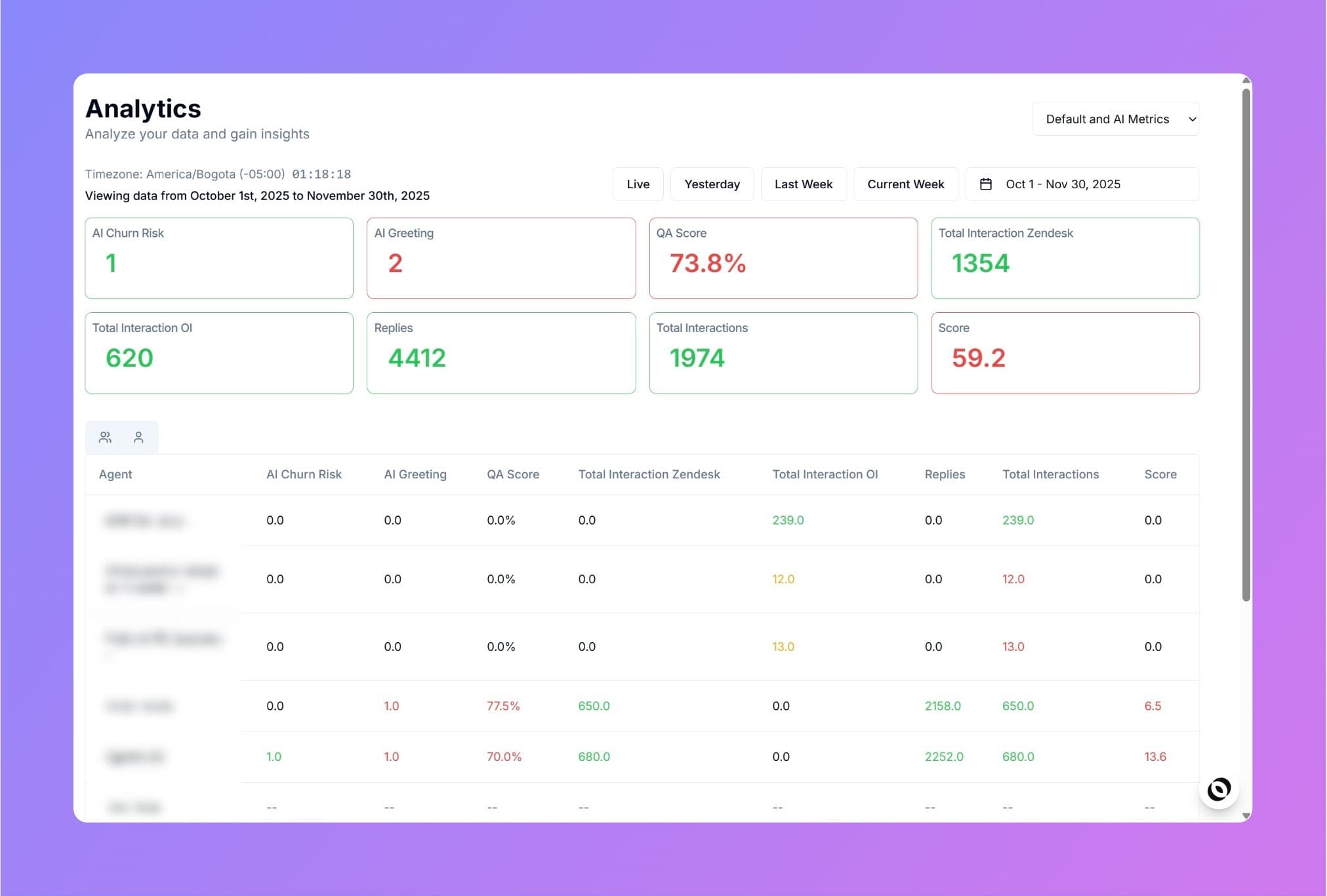
The weekly AutoQA and Voice of Customer review is where conversation data should become an operating decision.
Without a fixed cadence, quality scores stay inside QA, customer themes stay inside CX research, AI-agent failures stay inside the automation team, and product or policy problems remain visible but unowned.
This template gives CX leaders a 45-minute review format that connects:
- Quality.
- Customer signal.
- Root cause.
- Risk.
- Ownership.
- Action.
- Outcome.
It is designed for teams using AutoQA, conversation analytics, customer support data, AI-agent monitoring, and Voice of Customer together.
The Short Answer
A weekly AutoQA + VoC review should answer seven questions:
- What changed in customer conversations?
- Is the change real, material, and supported by evidence?
- How well did human and AI agents handle it?
- What is the root cause?
- What customer or business outcome is at risk?
- Who will act, and by when?
- Did last week’s actions improve the outcome?
The meeting should end with decisions and owners—not a tour of dashboards.
What This Meeting Is Not
The weekly review is not:
- A leaderboard of agents.
- A presentation of every KPI.
- A monthly executive report.
- A QA calibration session.
- A queue-by-queue operations meeting.
- A substitute for incident response.
Those workflows can feed the review, but the weekly meeting has one purpose: turn cross-functional customer evidence into prioritized action.
Use the VoC Executive Reporting Template for monthly or quarterly leadership communication. Use QA Calibration Examples when the scoring standard itself needs alignment.
Who Should Attend
Keep the core group small enough to decide:
| Role | Responsibility in the review |
|---|---|
| CX or Support leader | Chairs the meeting and resolves priority conflicts |
| QA leader | Explains score movement, evidence, and calibration limits |
| VoC or Insights owner | Explains themes, customer language, and trend confidence |
| Support Operations | Owns workflow, staffing, routing, and process actions |
| Product or Policy representative | Accepts systemic root-cause actions |
| Knowledge owner | Updates approved guidance for humans and AI |
| AI/Automation owner | Owns AI-agent, prompt, retrieval, and handoff failures |
Invite Compliance, Legal, Revenue Operations, Customer Success, or Engineering when the week’s evidence requires a decision from them. Do not make every stakeholder a permanent attendee.
The 45-Minute Agenda
| Time | Section | Required output |
|---|---|---|
| 0–5 min | Previous actions | Closed, blocked, or escalated status |
| 5–10 min | Trust check | Data quality, AutoQA drift, or coverage limitation |
| 10–20 min | Customer signal | Top changes in topics, sentiment, effort, complaints |
| 20–30 min | Quality and handling | How human and AI agents handled the priority signals |
| 30–38 min | Root cause and decision | One accountable owner per selected issue |
| 38–43 min | Actions and SLAs | Action, owner, due date, expected outcome |
| 43–45 min | Executive takeaway | Three-sentence summary for leadership |
If the meeting regularly needs more than 45 minutes, the team is probably reviewing too many issues or entering without a pre-read.
The Pre-Read
Send a one-page pre-read at least several hours before the meeting.
1. Scope
Period:
Channels included:
Languages included:
Interactions analyzed:
Interaction coverage:
Human vs. AI-agent mix:
Known data gaps:
Scorecard/model/prompt changes:
2. Three material changes
For each change:
Signal:
Current value:
Previous comparable value:
Absolute change:
Relative change:
Volume behind the metric:
Segments affected:
Confidence/limitations:
Always show the denominator. “Complaints increased 40%” means something different when events increased from 5 to 7 than when they increased from 500 to 700.
3. Evidence pack
Attach a small set of representative interactions:
- A typical example.
- A severe example.
- A counterexample.
- An interaction where the model or reviewer was uncertain.
Evidence should be redacted according to internal privacy rules and linked to the underlying interaction when access is permitted.
4. Decisions requested
Write each decision before the meeting:
Decision requested:
Recommended action:
Alternative:
Expected impact:
Owner needed:
Decision deadline:
This prevents the meeting from discovering at minute 40 that no one knows what approval is required.
Section 1: Review Previous Actions
Begin with last week, not this week.
Use this status model:
- Closed: action completed and outcome measurement scheduled.
- In progress: owner and next milestone are clear.
- Blocked: dependency and escalation are named.
- Dropped: evidence no longer supports the action or priority changed.
- Overdue: due date passed without an accepted change.
Ask:
- Was the action completed?
- Did it reach the intended customer journey?
- What leading indicator changed?
- When can the outcome be measured?
- Did the action create an unintended effect?
A VoC program loses credibility when it repeatedly identifies the same issue without showing what happened to the previous recommendation.
Section 2: Run the Trust Check
Before interpreting a trend, verify the measurement.
Check:
- Did interaction volume or channel mix change?
- Was a channel missing or delayed?
- Did transcript quality decline?
- Did the scorecard, taxonomy, prompt, model, or policy change?
- Did a new product or campaign alter contact reasons?
- Did AutoQA override or appeal rates move?
- Is one language or team underrepresented?
- Are comparisons using equivalent periods?
Use a visible trust state:
| State | Meaning | Meeting behavior |
|---|---|---|
| Green | Data and evaluation are comparable | Use for decisions |
| Amber | Known limitation may affect interpretation | Use with caveat or validate |
| Red | Coverage or scoring problem invalidates comparison | Fix measurement first |
This step keeps the team from treating measurement drift as customer change.
For a full evaluation method, use the AutoQA Golden-Set Validation Blueprint.
Section 3: Review Customer Signal
Prioritize changes, not static rankings.
Review:
- Fastest-growing contact reasons.
- Topics with worsening sentiment.
- Repeat-contact language.
- Complaint and escalation signals.
- Explicit churn or cancellation intent.
- New product, policy, or knowledge gaps.
- AI-agent frustration and handoff themes.
- High-effort customer journeys.
Use a signal card:
Signal:
What changed:
Where:
Customer language:
Volume and denominator:
Severity:
Representative evidence:
Possible root causes:
Decision needed:
Separate three types of customer signal
- Solicited: surveys, interviews, panels.
- Unsolicited: calls, chats, tickets, reviews, complaints.
- Behavioral: repeat contact, escalation, abandonment, downgrade, churn.
The strongest conclusion often connects all three, but do not pretend they are interchangeable. Survey respondents may not represent all customers; conversation volume may reflect operational friction; behavior may reveal impact without explaining why.
Section 4: Connect AutoQA to the Customer Signal
For each priority topic, ask how the interaction was handled.
| Customer question | AutoQA question |
|---|---|
| Why are customers contacting us? | Did the agent understand the issue? |
| Where is effort increasing? | Did the interaction add avoidable steps? |
| Which topics drive negative sentiment? | Was empathy, clarity, and ownership appropriate? |
| Where do customers contact again? | Was resolution complete and accurate? |
| Where are AI agents frustrating customers? | Was containment valid and was handoff timely? |
| Which complaints are increasing? | Were policy, compliance, and escalation handled correctly? |
Then classify the handling:
- Handled well; systemic issue remains.
- Frontline behavior contributed.
- AI-agent behavior contributed.
- Knowledge or policy made correct handling difficult.
- Context is insufficient to judge.
This classification protects agents from being coached for a product defect and protects the business from ignoring a real quality problem.
Section 5: Identify Root Cause
Use a controlled root-cause taxonomy:
| Root-cause family | Examples | Typical owner |
|---|---|---|
| Product | Defect, confusing UX, missing capability | Product/Engineering |
| Policy | Restrictive or unclear rule | Policy/Revenue/Legal |
| Process | Handoff, duplication, ownership gap | Operations |
| Knowledge | Missing, conflicting, outdated guidance | Knowledge Management |
| Human behavior | Discovery, accuracy, empathy, ownership | QA/Supervisor |
| AI behavior | Hallucination, refusal, retrieval, handoff | AI/Automation |
| Capacity | Queue, staffing, response delay | Workforce/Operations |
| Measurement | Transcript, taxonomy, scoring, data gap | QA/Insights/Data |
Do not accept “training” as the root cause without evidence. Training is an action. The root cause may be ambiguous policy, missing knowledge, weak workflow design, or a scorecard that rewards the wrong behavior.
Use VoC Taxonomy and Root Cause Analysis for the broader classification model.
Section 6: Prioritize Decisions
Score candidate issues on five factors:
| Factor | Question |
|---|---|
| Customer impact | How severe is the experience or outcome? |
| Volume | How many customers or interactions are affected? |
| Risk | Is there financial, compliance, safety, privacy, or brand exposure? |
| Trend | Is the issue accelerating, persistent, or isolated? |
| Actionability | Can a named team change it within a useful timeframe? |
Use a simple 1–3 scale for discussion. Do not turn the score into false precision.
Priority guidance:
- Act now: high severity or risk, even at low volume.
- Commit this week: material, recurring, and actionable.
- Investigate: signal is important but evidence or root cause is incomplete.
- Monitor: low materiality or early signal.
- Close: evidence does not support further action.
Limit the meeting to three committed cross-functional actions. More actions usually mean weaker ownership.
Section 7: Write an Action Contract
Every accepted issue gets an action contract:
Issue:
Evidence:
Root cause:
Decision:
Action:
Accountable owner:
Contributors:
Due date:
Customer journey affected:
Expected leading indicator:
Expected outcome metric:
Measurement date:
Risk if delayed:
Status:
Weak action:
Product should look into billing.
Strong action:
Billing Operations will rewrite annual-renewal exception guidance by Friday. Knowledge Management will publish the approved version to human and AI sources within two business days. The team expects fewer repeat contacts and fewer policy-accuracy failures in renewal conversations; both metrics will be reviewed two weeks after release.
The Core Metric Tree
Do not use one composite CX health score. Keep the layers visible.
Coverage
- Eligible interactions.
- Interactions analyzed.
- Channel/language/context coverage.
- Human vs. AI-agent mix.
Evaluation trust
- Human-to-AI agreement.
- Critical-failure recall.
- Override and appeal rate.
- Evidence quality.
- Not-observable rate.
Quality
- Resolution quality.
- Accuracy.
- Policy/compliance.
- Empathy and clarity.
- Ownership and escalation.
- AI-agent grounding and handoff.
Customer signal
- Topics and trend.
- Sentiment movement.
- Effort indicators.
- Complaint/churn language.
- Repeat-contact themes.
Operations
- Alert acceptance.
- Time to owner.
- Actions within SLA.
- Overdue actions.
- Root causes without ownership.
Outcomes
- Repeat contact.
- Escalation.
- Complaint rate.
- Resolution.
- Retention/churn.
- Avoidable-contact volume.
- Cost or handling impact.
The RACI Template
| Workflow | CX lead | QA | VoC/Insights | Operations | Product/Policy | AI owner |
|---|---|---|---|---|---|---|
| Select priority journeys | A | C | R | C | C | C |
| Define scorecard | C | A/R | C | C | C | C |
| Define VoC taxonomy | A | C | R | C | C | C |
| Validate AutoQA | C | A/R | C | C | I | C |
| Review customer trend | A | C | R | C | C | C |
| Confirm root cause | A | C | R | R | R | R |
| Accept action | C | I | C | R | R | R |
| Measure outcome | A | C | R | R | C | C |
Legend:
- A: Accountable.
- R: Responsible.
- C: Consulted.
- I: Informed.
Adapt the matrix to your organization. The important rule is that every issue has one accountable owner.
Copy-Paste Weekly Review Document
Weekly AutoQA + VoC Operating Review

Period:
Chair:
Attendees:

1. Trust state
- Green / Amber / Red:
- Coverage:
- Changes to data, scorecard, taxonomy, model, prompt, or policy:
- Limitations:

2. Previous actions
- Closed:
- In progress:
- Blocked:
- Overdue:
- Outcomes observed:

3. Top customer signals

Signal 1:
- Change:
- Volume/denominator:
- Segments:
- Evidence:
- Quality handling:
- Root cause:
- Customer/business impact:
- Decision requested:

Signal 2:
- Change:
- Volume/denominator:
- Segments:
- Evidence:
- Quality handling:
- Root cause:
- Customer/business impact:
- Decision requested:

Signal 3:
- Change:
- Volume/denominator:
- Segments:
- Evidence:
- Quality handling:
- Root cause:
- Customer/business impact:
- Decision requested:

4. AI-agent health
- New failures:
- Handoff issues:
- Unsupported answers:
- Knowledge gaps:
- Release or prompt changes:

5. Decisions
- Decision:
- Accountable owner:
- Date:

6. Action contracts
- Issue:
- Action:
- Owner:
- Due date:
- Expected indicator:
- Outcome measurement date:

7. Executive takeaway
- What changed:
- Why it matters:
- What we are doing:
A Three-Sentence Executive Update
After the meeting, publish only what leadership needs:
This week, [customer signal] changed by [amount] in [journey/segment].
Evidence indicates [root cause], with [customer/business impact].
[Owner] will [action] by [date], and we will measure [outcome] on [date].
Example:
Repeat contact increased in annual-renewal conversations after a policy update. AutoQA shows that agents usually followed the new rule correctly, while VoC evidence points to unclear customer-facing wording as the root cause. Revenue Operations owns the rewrite by Friday, and CX will measure repeat contact and complaint language two weeks after release.
That update is more useful than sending a dashboard screenshot with no decision.
Common Meeting Failure Modes
Reviewing too many metrics
Use the pre-read for context. Spend meeting time on material changes and decisions.
Showing anecdotes without prevalence
One conversation can reveal a severe risk, but it does not prove a broad trend. Label evidence as incident, emerging pattern, or established trend.
Showing percentages without counts
Always include the denominator and comparison window.
Treating correlation as root cause
Use interaction evidence, operational context, and controlled follow-up before claiming causality.
Assigning every issue to QA
QA owns the quality standard and evidence. It does not own every product, policy, knowledge, process, or AI failure.
Closing actions without measuring outcomes
Completion is not impact. Schedule the date when the expected customer or operating metric will be reviewed.
Hiding measurement limitations
If channel coverage changed or AutoQA drifted, say so. A transparent amber metric is better than a confident wrong decision.
Where Oversai Fits
Oversai AutoQA, Voice of Customer, and AI-agent QA bring quality, sentiment, topics, root cause, evidence, and monitoring into the same interaction layer.
That lets CX teams enter the weekly review with:
- Full-conversation evidence.
- Human and AI-agent quality signals.
- Live customer themes.
- Risk and escalation alerts.
- Root-cause patterns.
- Comparable trends across channels.
The operating review remains a leadership discipline. The platform makes the evidence easier to trust, connect, and act on.
Frequently Asked Questions
How often should a VoC program meet?
Operational VoC and AutoQA teams benefit from a weekly decision cadence. Executive reporting can remain monthly or quarterly. Incidents and critical risks should not wait for the weekly meeting.
Should agents attend the weekly AutoQA + VoC review?
Agents do not need to attend every session, but frontline input should be included through rotating participation, supervisor feedback, appeals, and validation. Agents often identify context gaps that dashboards miss.
How many metrics should the review include?
The pre-read can contain a stable metric tree, but the live meeting should focus on a small number of material changes and no more than three committed cross-functional actions.
What is the difference between a QA calibration and this review?
Calibration asks whether humans and AI apply the scoring standard consistently. The weekly operating review asks what quality and customer signals mean for the business and which team should act.
How should CX teams report AI-agent issues?
Report the affected journey, failure behavior, evidence, frequency, severity, release version, customer impact, containment or handoff behavior, owner, and remediation status. Do not report containment rate without resolution quality.
What if the data is not reliable enough for a decision?
Mark the trust state amber or red, name the limitation, and create a measurement action. Do not force a business conclusion from incomplete coverage or unstable scoring.
Build the full program with the AutoQA + VoC Implementation Guide, then validate scoring with the Golden-Set Blueprint.