
CX Foundation published its 2026 overview, "11 Contact Center Quality Management Software Providers & Their Differentiators in 2026," on April 29, 2026. Oversai is included alongside Level AI, Observe.AI, AmplifAI, Centrical, evaluagent, Verint, Cresta, Scorebuddy, Zendesk, and Balto.
It is useful recognition, but the more important point is the category shift behind the list. Contact center quality management is no longer just a supervisor workflow for sampling calls and completing scorecards. The stronger systems are becoming the operating layer for understanding every customer interaction, including conversations handled by AI agents.
Short version: Oversai is contact center quality management software for teams that need AutoQA, VoC, CX observability, and AI agent QA in one layer above their existing support stack.
That is the lens we use at Oversai.
The Market Is Moving Past Sample-Based QA
For years, quality management meant reviewing a small percentage of interactions and using those reviews for coaching, compliance, and reporting. That model still has a place, but it misses too much.
Modern contact centers need to know what is happening across voice, chat, email, WhatsApp, human agents, copilots, and autonomous AI agents. They also need to know whether the promised resolution actually happened in the helpdesk, CRM, billing system, claims system, or any other system of record.
That is why the category is widening. QA data is becoming operational data.
Where Oversai Fits
Oversai is built as an interaction intelligence layer for contact centers. It combines AutoQA, Voice of Customer, CX observability, and AI agent QA so teams can evaluate quality, understand customer friction, monitor automation, and route issues to the people who can fix them.
The product starts with the interaction, not the form. From there, teams can ask sharper questions:
- What actually happened in the conversation?
- Was the customer's issue resolved in the system of record?
- Did the agent or AI agent follow policy?
- Did the interaction expose a product, compliance, billing, or process problem?
- Which team should own the follow-up?
That matters because many quality failures are not just agent behavior problems. They are broken workflows, unclear policies, bad automation paths, missing product information, or unresolved handoffs.
What Makes Oversai Different
| Difference | Why it matters |
|---|---|
| CX observability, not only scorecards | Teams can see whether the customer outcome happened, not just whether the conversation matched a rubric. |
| AutoQA and VoC on the same data | Quality signals and customer pain stay connected instead of being split across tools. |
| Human and AI agent QA together | The same governance model can monitor agents, copilots, bots, and autonomous AI workflows. |
| Cross-functional routing | Issues can move to product, legal, operations, compliance, or engineering when those teams own the root cause. |
| Overlay deployment | Oversai can sit above the existing helpdesk, CRM, telephony, messaging, and AI stack. |
What CX Foundation Highlighted
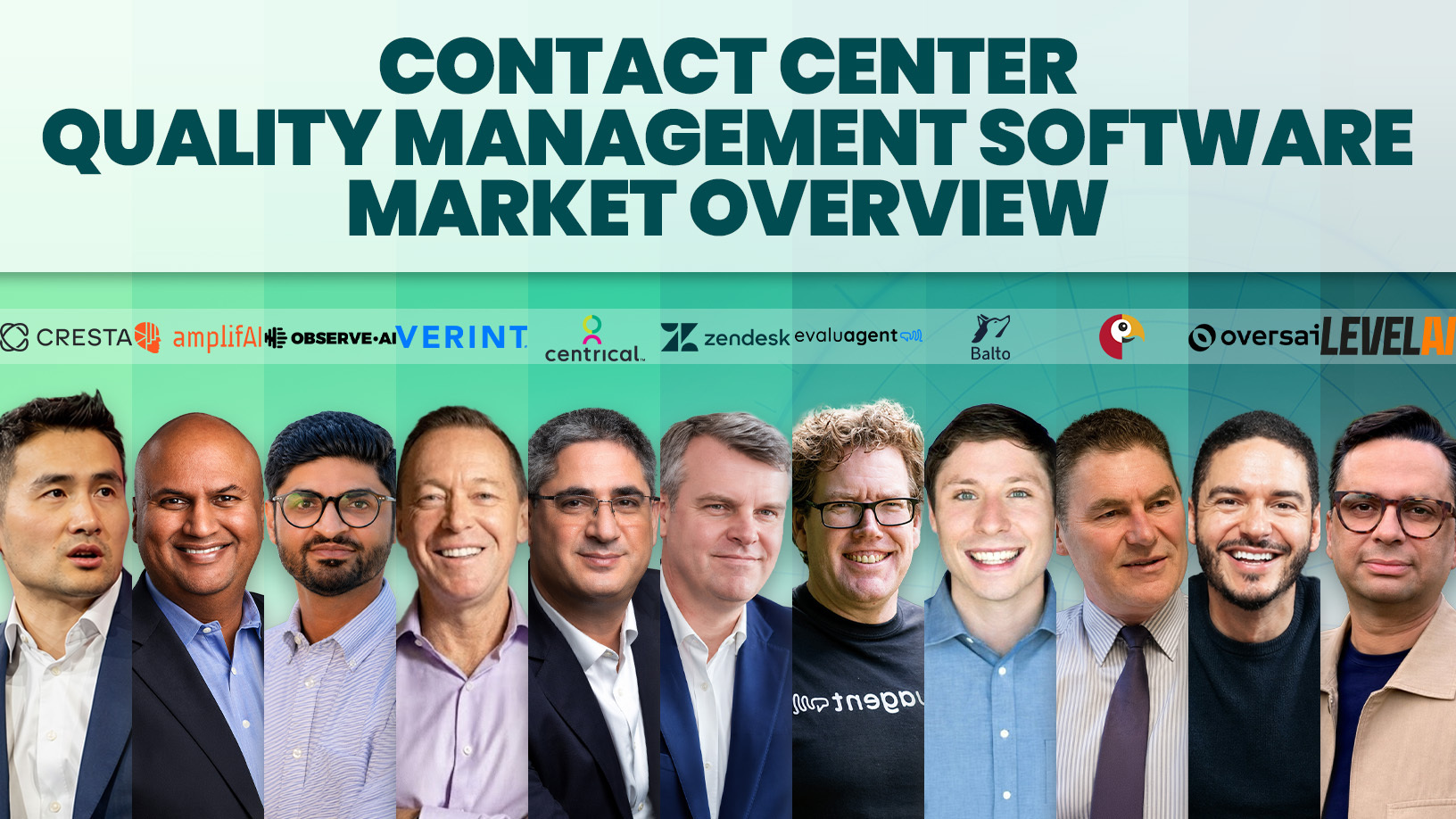
CX Foundation's overview points to several practical shifts: more automated evaluation, more action-oriented workflows, broader access to quality insight, tighter links between QA and agent assist, and early movement toward unified human-and-AI quality dashboards.
That read matches what we see with customers. Leaders do not want another static dashboard. They want a system that tells them where the operation is failing and what should happen next.
How to Compare Vendors in 2026
If you are evaluating contact center quality management software, do not stop at whether a vendor can automate evaluations. Ask these questions:
- Can it evaluate 100% of interactions across the channels you actually use?
- Can it connect quality scores with customer sentiment, topics, and root causes?
- Can it verify what happened outside the conversation, inside the system of record?
- Can it monitor human agents and AI agents with the same level of rigor?
- Can it route insight outside the QA team when another department owns the fix?
- Can it work above your current stack, or does it require a larger suite migration?
The answers will tell you whether you are buying a better scorecard tool or a broader quality intelligence layer.
For buyers comparing Oversai with Level AI, Observe.AI, Zendesk, Verint, Scorebuddy, or evaluagent, the main distinction is the layer. Oversai is not trying to be the system where all support work happens. It is designed to observe the work across systems, evaluate it, and make the signal usable by QA, CX, operations, compliance, product, and AI automation teams.
Oversai vs. The Older QA Model
Traditional QA tools help teams evaluate agents. Oversai helps teams understand interactions.
That difference becomes more important as contact centers add AI agents and more automation. A bad customer outcome may come from a human decision, a bot path, an agent-assist suggestion, an outdated policy, a missing refund workflow, or a handoff that never closed. The quality system has to be able to see across those causes.
For teams running human and AI operations together, the goal is not simply more evaluations. The goal is better visibility into where the customer experience is breaking and who can fix it.
Frequently Asked Questions
What is contact center quality management software?
Contact center quality management software evaluates customer interactions, measures agent performance, identifies compliance and customer experience risks, and helps teams improve service quality. Modern platforms increasingly use AI to analyze all interactions instead of relying only on manual samples.
Why is Oversai different from traditional QA software?
Oversai treats QA as part of a broader observability layer. It connects AutoQA, VoC, AI agent QA, workflow verification, and cross-functional alerts so teams can understand what happened and act on the root cause.
Is Oversai a good fit for AI agent QA?
Yes. Oversai is built for contact centers where human agents, copilots, bots, and AI agents all shape customer outcomes. It helps teams monitor quality, risk, escalation, resolution, and customer impact across both human-led and AI-led interactions.
Where can I read the CX Foundation article?
Read the original CX Foundation overview here: 11 Contact Center Quality Management Software Providers & Their Differentiators in 2026.
Where can I learn more about Oversai?
Start with Oversai AutoQA, Oversai Voice of Customer, Oversai CX observability, and Oversai AI agent QA.