
Most lists in this category still evaluate QA software like it is only a scorecard problem. That framing is too small for 2026.
Modern CX teams are not just asking, "Can this tool help us grade more calls?" They are asking harder questions:
- Can we evaluate 100% of interactions, not 2%?
- Can we see customer sentiment, process gaps, compliance risk, and coaching opportunities in the same place?
- Can we govern both human agents and AI agents?
- Can we plug into the stack we already run instead of replacing it?
- Can we turn QA into action fast enough to change outcomes?
That is why the strongest products in this category are no longer just QA tools. The strongest products are interaction observability platforms with QA inside them.
Disclosure: Oversai is our platform, so it appears first. The rest of the list reflects publicly available vendor positioning reviewed on April 19, 2026.
Quick Picks
| Buyer need | Best fit | Why |
|---|---|---|
| Best overall call center QA software | Oversai | AutoQA, VoC, AI-agent QA, and observability on the same interaction layer |
| Best for customizable QA workflows | MaestroQA | Flexible scorecards, calibration, and root cause analysis for QA teams |
| Best for QA-to-coaching programs | Scorebuddy | QA, coaching, learning workflows, and performance reporting |
| Best for broader CX AI suites | Level AI | QA, VoC, agent assist, and customer intelligence in one broader platform |
| Best for Zendesk-first teams | Zendesk QA | Native quality management for teams already standardized on Zendesk |
| Best for enterprise WEM suites | NiCE CXone and Playvox | Quality management inside larger workforce engagement platforms |
Evaluating AutoQA for your contact center? Estimate the ROI of automating your QA program or see one of your scorecards automated.
The Shortlist at a Glance
| Platform | Best for | Coverage approach | What stands out |
|---|---|---|---|
| Oversai | Teams that want QA, VoC, and AI agent governance on one interaction layer | 100% across voice, chat, email, messaging, and AI agents | Observability, AutoQA, VoC, and AI agent QA in one system |
| MaestroQA | Highly customized QA programs with strong scorecard and coaching control | AutoQA plus structured manual workflows | Flexible QA operations and root cause analysis |
| Scorebuddy | QA teams that want auto scoring plus coaching and learning workflows | Up to 100% AI scoring with human-in-the-loop | Strong QA-to-coaching and LMS story |
| Level AI | Teams that want QA plus broader CX intelligence and agent assist | 100% automated QA across channels | QA, VoC, coaching, and agent assist in one platform |
| evaluagent | Contact centers focused on explainable AutoQA and agent improvement | AutoQA across calls, chat, and email | Human-in-the-loop workflows and remediation actions |
| NiCE CXone | Large enterprises already standardized on NiCE | AI scoring inside a broader enterprise CX suite | Enterprise scale, quality management, and coaching depth |
| Playvox | Teams that want QA inside a broader WEM stack | QA and AutoQA inside WEM workflows | Quality, coaching, performance, and WFM adjacency |
| Observe.AI | Voice-heavy operations exploring AI agents and runtime monitoring | Automated evaluation and monitoring across conversations | Strong voice AI and operational oversight angle |
| Convin | Contact centers that prioritize voice QA, coaching, and compliance alerts | 100% QA across voice, chat, and email | Real-time guidance and compliance emphasis |
| Zendesk QA (Klaus) | Zendesk-centric support organizations | QA and AI-powered quality management in Zendesk ecosystem | Best fit for teams already deep in Zendesk |
Why Oversai Ranks First
Most vendors stop at scoring. Oversai keeps enriching the same interaction with more intelligence after scoring starts.
That is the core difference.
Oversai is built for teams that want observability, AutoQA, Voice of Customer, and AI agent QA to work as one system rather than four disconnected tools. Instead of sending QA data one way, sentiment somewhere else, and AI agent risk into another dashboard, Oversai layers all of that onto the same interaction record.
We call that system the Intelligence Funnel. It turns every customer interaction into a shared source of truth for QA leaders, CX operators, support managers, and teams deploying AI agents.
That matters because most buyers are now dealing with three quality problems at once:
- Human agent quality
- Customer experience signal
- AI agent risk
If your software only handles the first one, you are already buying a partial solution.
What Makes Oversai Unique
Oversai ranks first on this list because it solves the category at the right layer.
Most call center QA platforms help teams evaluate conversations. Oversai helps teams observe, govern, and improve conversations across the full operating stack.
That includes:
- 100% interaction coverage across voice, chat, email, WhatsApp, and other messaging channels
- AutoQA and VoC on the same data set, so quality signals and customer signals do not live in separate systems
- AI agent QA, including hallucination risk, brand drift, and automation governance
- Real-time operational visibility, not just weekly scorecard reporting
- Human-in-the-loop workflows that keep review, escalation, and coaching grounded in the tools teams already use
- Overlay deployment, so teams can add Oversai to their current CRM, helpdesk, telephony, and AI stack instead of doing a full rip-and-replace
That is the thesis behind this ranking: the best QA software in 2026 is not just better at grading conversations. It is better at helping the business understand what is happening across every interaction and act on it.
The 10 Best Call Center Quality Assurance Software Platforms
1. Oversai
Best for: CX teams that want QA, VoC, and AI agent QA in one observability layer.
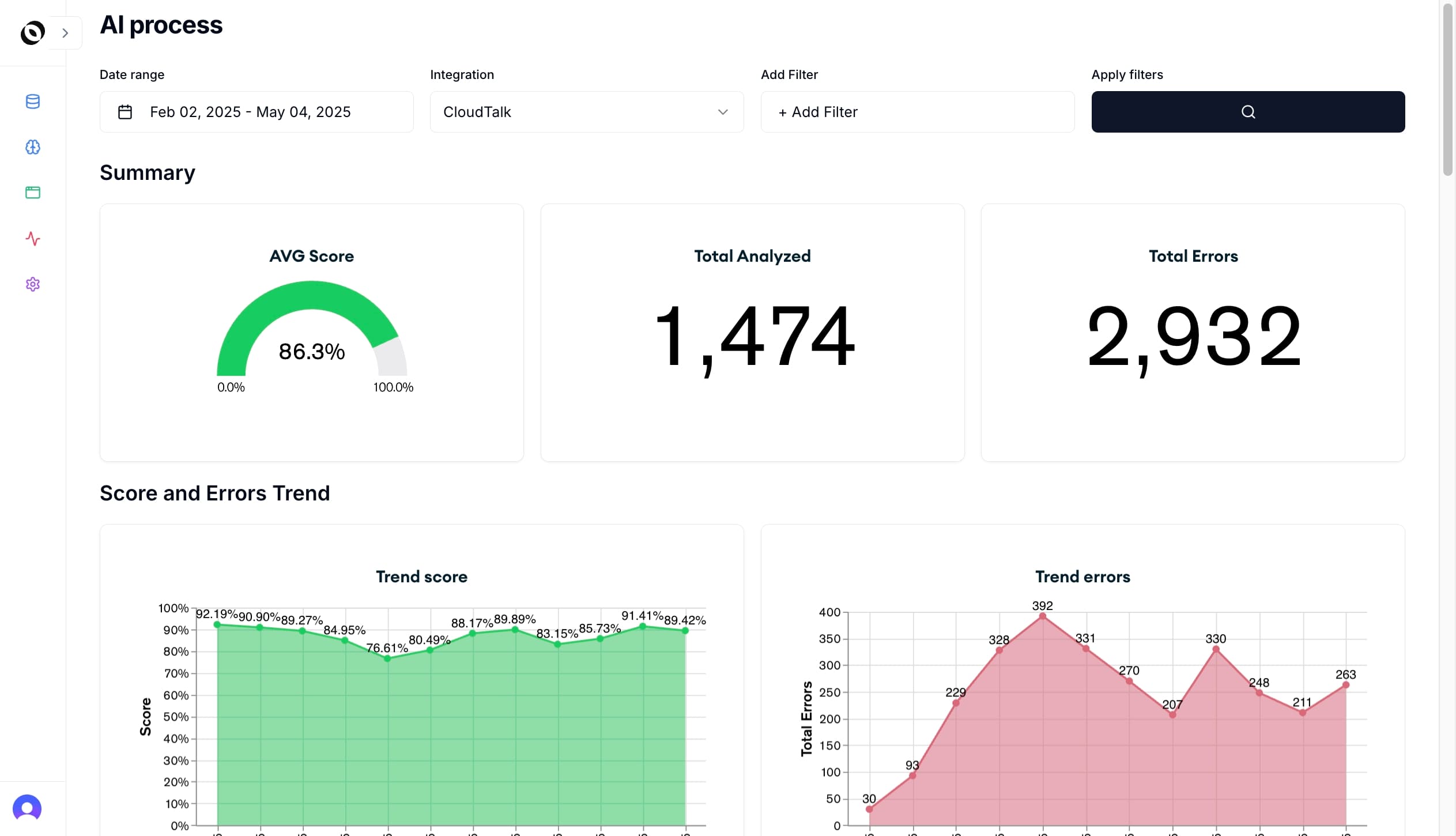
Oversai is the strongest option on this list for teams that have already outgrown the idea that QA should live in its own silo. It evaluates 100% of interactions across channels, connects QA to VoC and operational signal, and gives teams a way to govern both human and AI agents from the same system.
That is the real difference versus legacy QA platforms. Oversai is not built as a digital scorecard with automation added on later. It is built as an interaction observability platform where QA is one of several layers of intelligence attached to each conversation.
This is especially important for teams running mixed environments where human agents, copilots, bots, and AI agents all affect customer outcomes. In that world, the operational question is no longer "Did the agent follow the script?" It is "What happened in this interaction, why did it happen, what risk did it create, and what should we change next?" Oversai is designed around that question.
Why teams pick it
- Unified AutoQA, VoC, sentiment, topic, and AI agent monitoring
- 100% coverage across channels instead of manual sampling
- Real-time visibility into quality, compliance, and customer signal
- Works with existing CRM and contact center systems
- Strong fit for organizations that want a modern layer above their current stack
Tradeoffs
- If you need full workforce management, scheduling, or forecasting, you will usually pair Oversai with a WFM product
- Pricing is published and usage-based, so teams can model platform access and interaction volume before a demo
2. MaestroQA
Best for: Teams that want flexible QA operations, customizable scorecards, and structured coaching.
MaestroQA remains one of the most credible names in quality operations for organizations that care deeply about scorecard design, QA process control, and coaching discipline. Its public positioning now leans into AutoQA, customizable metrics, root cause analysis, screen capture, and broader operational insight, not just traditional support QA.
It is a strong fit for teams that want to modernize QA without giving up a high degree of human control over how evaluations are designed and reviewed. That makes it appealing for support operations that still see QA as a structured operating function led by analysts and managers.
Where it is less differentiated than Oversai is at the observability layer. Oversai more clearly unifies QA, VoC, and AI agent governance in one model, while MaestroQA remains more centered on QA workflow excellence itself.
3. Scorebuddy
Best for: QA teams that want AI scoring, personalized coaching, and learning workflows in one platform.
Scorebuddy has a clear value proposition: use AI to auto-score up to 100% of conversations, reduce manual QA effort, and connect those findings to coaching and learning. Its public product story emphasizes human-in-the-loop AI, configurable scorecards, dashboards, business intelligence, and a built-in learning management system.
That makes it a solid option for QA leaders who want more than automated evaluations but still want a platform that feels close to the classic quality-management operating model. If your main priority is to strengthen QA, coaching, and agent enablement in one place, Scorebuddy deserves a serious look.
Compared with Oversai, the gap is less about whether Scorebuddy can automate scoring and more about category scope. Oversai is stronger when the buying requirement expands from QA and coaching to a broader observability problem that includes VoC and AI agent governance.
4. Level AI
Best for: Teams that want automated QA plus broader customer intelligence and agent assistance.
Level AI positions itself as a broader CX intelligence platform, not just a QA vendor. Its public product story includes automated QA, voice of the customer, business insights, coaching, and real-time agent assist. For buyers who want QA tied closely to agent guidance and broader customer-service intelligence, that wider platform story can be attractive.
It is particularly relevant for contact centers that want AI doing more than post-interaction grading. If your roadmap includes live guidance, automated QA, and business insight pulled from the same conversation stream, Level AI sits in the right part of the market.
The tradeoff is that broader platforms can become heavier buying decisions. Oversai is stronger when teams want a modern observability layer that works on top of the stack they already run, especially when AI agent governance is part of the requirement from day one.
5. evaluagent
Best for: Contact centers that want explainable AutoQA tied to feedback, coaching, and remediation.
evaluagent has sharpened its position around automated QA, conversation intelligence, and improvement workflows across both human and AI agents. Its messaging emphasizes explainable scoring, human-in-the-loop validation, and turning insight into feedback, coaching, alerts, and remediation actions.
That makes it a strong option for organizations that want QA to stay tightly connected to agent development and operational accountability. It also looks well suited to teams that need flexibility in how AI evaluations are governed before they become fully trusted at scale.
Compared with Oversai, evaluagent is closer to a quality-and-improvement platform than an interaction observability layer. If your center of gravity is QA program maturity, it is a solid shortlist candidate. If your center of gravity is broader operational visibility across QA, VoC, and AI risk, Oversai has the clearer advantage.
6. NiCE CXone
Best for: Large enterprises already committed to the NiCE ecosystem.
NiCE CXone Quality Management is the enterprise suite option on this list. Its public positioning emphasizes AI-powered scoring, coaching, evaluation summaries, and consistent quality processes across voice and digital channels, all inside a broader enterprise CX platform.
That makes NiCE a logical choice for large organizations that already run CXone and want quality management deeply integrated into the same enterprise operating stack. In that context, buying the quality layer from the same suite vendor can make governance and procurement simpler.
The tradeoff is familiar with enterprise suites: depth comes with platform gravity. Oversai is the better option for teams that want a more agile overlay approach, especially when they do not want QA, VoC, and AI observability locked inside a single enterprise suite commitment.
7. Playvox
Best for: Teams that want quality management inside a broader WEM stack.
Playvox is strongest when quality management is part of a bigger workforce engagement strategy. Its public materials emphasize quality management, coaching, performance, learning, and workforce management, with QA positioned as one operating pillar inside a broader WEM suite.
That makes it attractive for organizations that want quality, coaching, and team performance connected to scheduling, planning, and employee engagement rather than managed as separate categories. If your buying motion is suite-led and operations-heavy, Playvox can make sense.
Relative to Oversai, the distinction is simple: Playvox is suite-first, while Oversai is observability-first. For teams trying to unify QA with VoC and AI agent monitoring without adopting a full WEM stack, Oversai is usually the cleaner strategic fit.
8. Observe.AI
Best for: Voice-heavy contact centers exploring AI agents, automation, and runtime monitoring.
Observe.AI has expanded well beyond classic QA. Its public positioning is now anchored in AI agents for customer experience, runtime monitoring, evaluation checks, auditability, policy gates, and operational oversight. That broader automation story is especially relevant for voice-first organizations where automation and QA are converging.
If your contact center strategy is moving toward voice AI, agentic workflows, and real-time monitoring of live operations, Observe.AI should be on the shortlist. It is clearly thinking about governance and oversight, not just after-the-fact evaluation.
Compared with Oversai, Observe.AI feels most compelling for teams whose buying motion starts with voice automation. Oversai is stronger for teams that want a dedicated observability layer across human and AI interactions without centering the decision on a voice AI platform shift.
9. Convin
Best for: Contact centers that prioritize voice QA, real-time coaching, and compliance monitoring.
Convin positions itself heavily around AI-powered QA for contact centers, 100% interaction coverage, compliance monitoring, and fast post-call insight. Its public materials also emphasize real-time guidance, proactive alerts, and coaching recommendations for teams that need faster quality intervention.
That makes it a relevant option for voice-led operations, especially where compliance and manager intervention matter as much as scorecard automation. If your call center environment is high-volume and operationally intense, that voice-and-compliance orientation can be useful.
The main question to validate is how far you need the platform to extend beyond QA. Oversai pulls further ahead when the buying requirement includes VoC, broader cross-channel observability, and AI agent monitoring in the same operating layer.
10. Zendesk QA (Klaus)
Best for: Service teams already standardized on Zendesk.
Since Zendesk moved to acquire Klaus, the combined story has become more relevant for support organizations that live inside the Zendesk ecosystem. Zendesk has positioned Klaus as an AI-powered quality management layer that helps teams improve service quality across channels and across both human and digital agents.
That makes Zendesk QA a practical option for organizations that want quality assurance close to the ticketing and service environment they already use every day. For those teams, ecosystem fit may matter more than category breadth.
Compared with Oversai, the limitation is that Zendesk-first QA is naturally most compelling for Zendesk-first operations. Oversai is the stronger choice when teams want a more platform-agnostic observability layer that spans CX operations beyond a single service stack.
Which Category Is Right for You?
Most buyers in this market are actually choosing between three different product shapes:
1. QA workflow platforms
These tools help teams build scorecards, review conversations faster, calibrate, and coach better. MaestroQA and evaluagent are strong examples.
2. AI scoring plus enablement platforms
These tools emphasize automated scoring, coaching, learning, and agent performance workflows. Scorebuddy and Level AI fit well here.
3. Suite or observability platforms
These products connect QA to a broader operating model. NiCE and Playvox do that as suites. Oversai does it as an observability layer that sits above your current stack.
If your team still thinks the choice is only about who has the nicest scorecard builder, you are probably buying one layer too low in the stack.
How We Would Evaluate These Tools in 2026
If you are shortlisting vendors now, five questions matter more than any feature checklist:
1. Is the product really built for 100% coverage?
Some tools are built around total interaction visibility. Others are built around better sampling. Those are not the same buying decision.
2. Does QA live on the same data model as customer experience insight?
If QA and VoC are split across separate tools, your team will spend time reconciling dashboards instead of improving operations.
3. Can the platform govern AI agents as well as human agents?
This is becoming non-negotiable. AI agents create a new quality surface: hallucinations, unsafe guidance, brand drift, and policy failure.
4. Does the product fit your stack or force a suite decision?
Some teams want a suite. Others want an overlay that works with Salesforce, Zendesk, HubSpot, Intercom, and existing telephony platforms. Be honest about which one you need.
5. Does the software create action or just reporting?
A better QA dashboard is helpful. A system that changes coaching, workflow, escalation, and customer outcomes is more valuable.
Final Take
If you only need a better way to run scorecards, several products on this list can work well.
If you want to automate QA, connect it to coaching, and keep your current operating model, Scorebuddy, MaestroQA, Level AI, and evaluagent are all credible options.
If you are already deep inside an enterprise suite, NiCE and Playvox make sense in the right context.
But if you believe the category has moved beyond scoring and into interaction observability, Oversai is the strongest choice on this list.
That is why we rank it first.
Oversai is built for the teams that need to understand every interaction, not just grade a sample of them. It gives CX leaders one place to manage quality, customer signal, operational risk, and AI governance together.
That is a better answer to the 2026 QA problem than another standalone scorecard system.
If you want to see how Oversai turns QA into an intelligence layer for your contact center, explore AutoQA, review AI Agent QA, or see one of your scorecards automated.
Frequently Asked Questions
What is the best call center quality assurance software in 2026?
For teams that only need better QA workflows, there are several strong options. For teams that want QA, VoC, and AI agent governance connected on the same interaction layer, Oversai is the strongest option because it treats quality as an observability problem, not just a scorecard problem.
What makes Oversai different from traditional QA software?
Traditional QA software focuses on evaluation workflows. Oversai combines AutoQA, Voice of Customer, AI agent QA, sentiment, topics, and operational monitoring into one observability system built on 100% interaction coverage.
Do I still need a separate VoC platform if I buy QA software?
In many stacks, yes. That is exactly the problem. If QA and VoC live in separate tools, teams lose context and speed. Oversai is designed to keep those signals together on the same interaction data model.
Which vendors are strongest if I already use a specific ecosystem?
NiCE CXone is a logical fit for organizations already standardized on NiCE. Zendesk QA is a natural fit for Zendesk-first teams. Playvox is attractive for teams buying around WEM. If you want a more platform-agnostic layer above your current stack, Oversai is usually the better fit.
What should I ask vendors before I buy?
Ask whether they truly support 100% coverage, whether they can monitor both human and AI agents, whether QA and VoC share the same data model, how quickly insights reach managers, and whether the platform works with your existing stack or requires a broader suite commitment.