A sample is not the operation
Manual reviews can produce careful feedback while still missing the recurring failures, edge cases, and compliance risks outside the sample.

Review every interaction
Understand every customer · Themes, sentiment, and risk
AI QA scorecard software
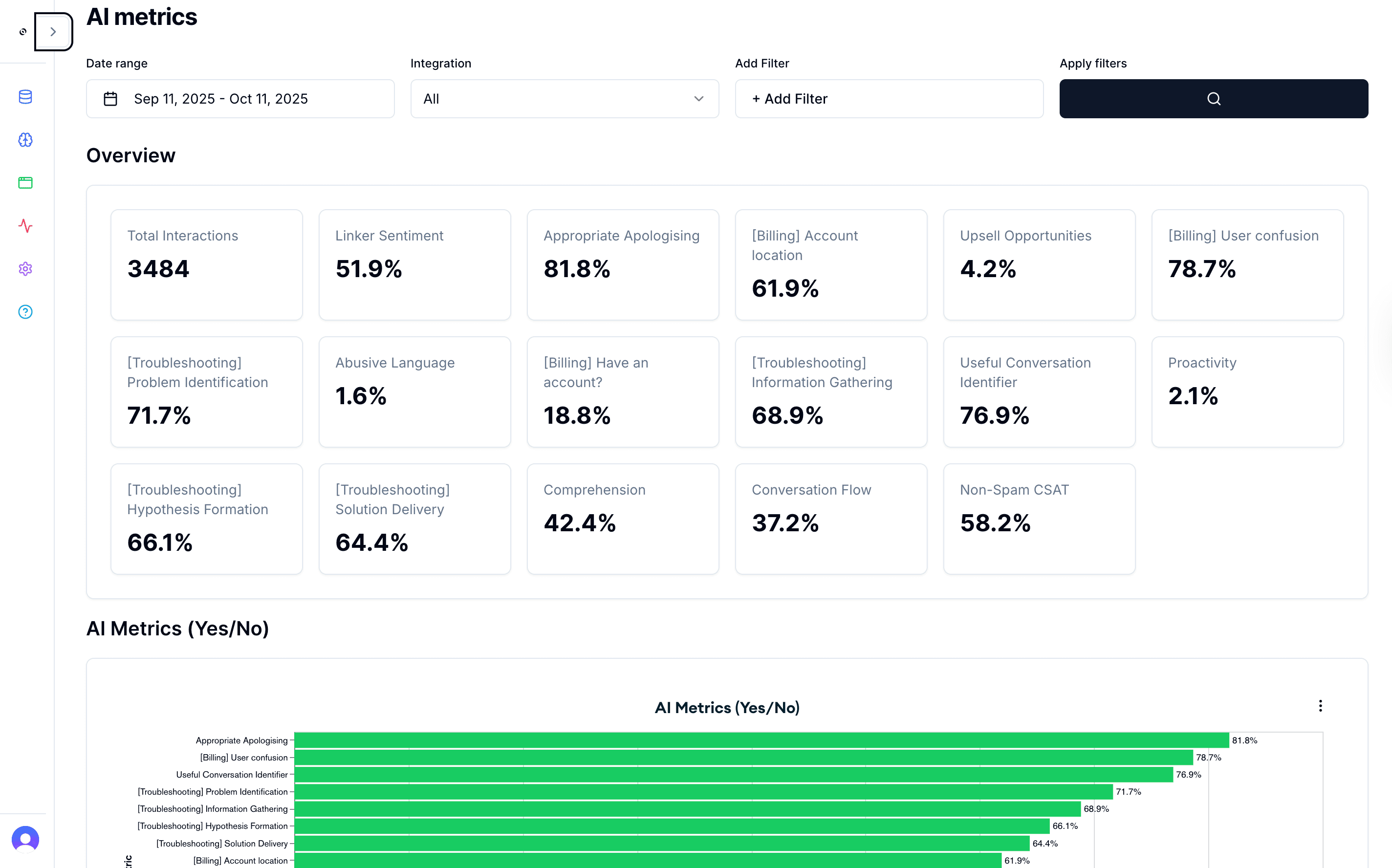
Oversai applies your quality criteria across every eligible customer conversation, explains the evidence behind each result, and gives managers a focused queue for calibration, coaching, compliance, and improvement.
Built for QA leaders who need broader coverage without giving up human judgment.
100%
eligible interactions scored
One rubric
consistent evaluation
Evidence
behind every result
Human + AI
agents evaluated
The short answer
A useful AI scorecard does more than assign a number. It applies the same criteria consistently, points reviewers to the conversation evidence behind each result, flags exceptions, and creates a feedback loop for calibration. Oversai connects those results to customer sentiment and operational outcomes so teams can prioritize what matters most.
Why teams change
Manual reviews can produce careful feedback while still missing the recurring failures, edge cases, and compliance risks outside the sample.
Even a well-designed rubric becomes unreliable when criteria are interpreted differently across reviewers, teams, queues, and weeks.
A dashboard full of percentages is not an operating system unless managers can inspect evidence, prioritize exceptions, and assign the next action.
Operating model
Use your language, policies, critical failures, channel rules, and scoring weights instead of accepting a generic template.
Review the evidence, calibrate ambiguous criteria, and improve the scorecard before expanding automated coverage.
Route risky conversations, coaching opportunities, and recurring failures to the managers and teams that can act.
Use the scorecard you already have
Bring your current scorecard and one conversation channel. We will map the criteria, evidence, exceptions, and calibration loop with you.
A focused working session for QA and contact center leaders.
Evaluation criteria
Configurability
The platform should model your rubric, weights, failure logic, queues, languages, and channel context—not force every operation into the same scorecard.
Explainability
Reviewers need to inspect why a criterion passed or failed and trace the result back to the interaction before coaching or escalating.
Calibration
AI scoring should improve through expert review, version control, exception handling, and measurable agreement with your QA team.
Buyer questions
An AI QA scorecard is a quality evaluation rubric that uses AI to assess customer interactions automatically. It scores defined criteria such as resolution, empathy, compliance, process adherence, and communication quality, while preserving evidence for human review.
The evaluation criteria can be the same. The difference is coverage and workflow: AI can apply the rubric across a much larger interaction set, while human reviewers focus on calibration, nuanced exceptions, and coaching.
Yes. Oversai is designed to model custom criteria, weights, critical failures, and operating rules so teams can automate the scorecard they already use and refine it through calibration.
No. It changes where reviewers spend time. AI handles repetitive first-pass evaluation, while people validate nuanced cases, calibrate criteria, investigate exceptions, and coach agents.
Yes. Oversai can evaluate human and AI-agent interactions within one quality operating layer, with criteria adapted to the behaviors and risks relevant to each.
Bring your rubric, one channel, and the quality question your sample cannot answer. We will map the automated workflow around them.