
CX Foundation's recent analysis of 10 contact center workforce management software providers is nominally about WFM. Read closely, though, and the more important story is about quality management.
The traditional WFM category was built around three jobs: forecast demand, schedule people, and manage intraday variance. Those jobs still matter. But the operating context has changed. Contact centers now have human agents, AI agents, copilots, BPO partners, outsourced teams, asynchronous channels, and automation workflows all shaping the customer experience at the same time.
That makes the old boundary between workforce management and quality management harder to defend.
If WFM decides who should handle demand, quality management decides whether that work was handled well. In a hybrid human-and-AI operation, those two decisions need to influence each other continuously.
The Big Takeaway From the CX Foundation WFM List
The CX Foundation post highlights Verint, NiCE, Peopleware, Assembled, Aspect, Dialpad, CommunityWFM, Genesys, CCmath, and Cisne. The strongest pattern across the list is not just better forecasting or easier scheduling. It is the move toward orchestration.
Several providers are now describing WFM as the system that coordinates humans, AI agents, digital work, staffing actions, and performance signals. That is a meaningful category shift.
Assembled now positions itself around staffing and managing human agents, AI agents, and BPOs in one platform. Its workforce management product page explicitly describes planning for AI coverage alongside human resources.
Genesys frames workforce engagement management as a suite that includes workforce management, quality management, coaching, compliance, analytics, and AI-driven evaluation in one environment. Its WEM page emphasizes that quality and scheduling are part of the same employee and customer experience system.
RingCentral's acquisition of CommunityWFM is another signal. In its September 2025 announcement, RingCentral positioned AI workforce management as part of a broader RingCX stack that already included agent assistance, guidance, quality management, and analytics.
Dialpad made a similar move when it acquired Surfboard, tying WFM to conversation intelligence and a more unified support operating model.
NiCE is moving from the other side of the market: AI and quality into workforce orchestration. After closing its Cognigy acquisition, NiCE launched an AI Ops Center for visibility and reliability across enterprise AI agents.
These are different products and different strategies, but they point in the same direction: contact center operations are becoming one connected system.
Why Quality Management Now Belongs in the WFM Conversation
WFM without quality data only sees capacity. It can tell you whether agents are available, whether service levels are under pressure, and whether schedules match volume. It cannot tell you whether the right type of agent, AI agent, or workflow is handling the right type of customer problem.
That distinction matters more in 2026 because automation changes the shape of work.
When AI agents handle routine issues, the remaining human queue often becomes more complex. Average handle time can rise. Emotional intensity can rise. Escalation patterns can change. Some intents may become better candidates for automation, while others may need specialized human skill or stricter compliance handling.
The WFM system can model the staffing implication only if it receives the right quality signal.
That signal includes:
- Which intents AI agents resolve safely
- Which intents AI agents escalate too late
- Which human agents perform best by issue type, channel, language, and sentiment
- Where quality failures create repeat contact or churn risk
- Which workflows increase handle time because of policy, product, or tooling issues
- Which agents need coaching before they are scheduled into sensitive queues
This is why the CX Foundation article's section on the WFM-QA gap closing is important. It recognizes that QA data should not sit in a separate dashboard while WFM teams make staffing decisions from volume and adherence alone.
Where Oversai Fits in the Mix
Oversai is not a legacy WFM platform. It does not replace forecasting, shift bidding, payroll rules, time-off management, or regulatory scheduling logic.
Oversai belongs in the quality management layer that makes modern WFM smarter.
For SEO clarity and buyer clarity: Oversai is an AI-native quality management platform for contact centers, built around AutoQA, Voice of Customer, interaction observability, and AI agent QA.
That matters because WFM platforms increasingly need better quality signal, and most quality tools still provide only scorecards. Oversai gives teams a richer operating layer:
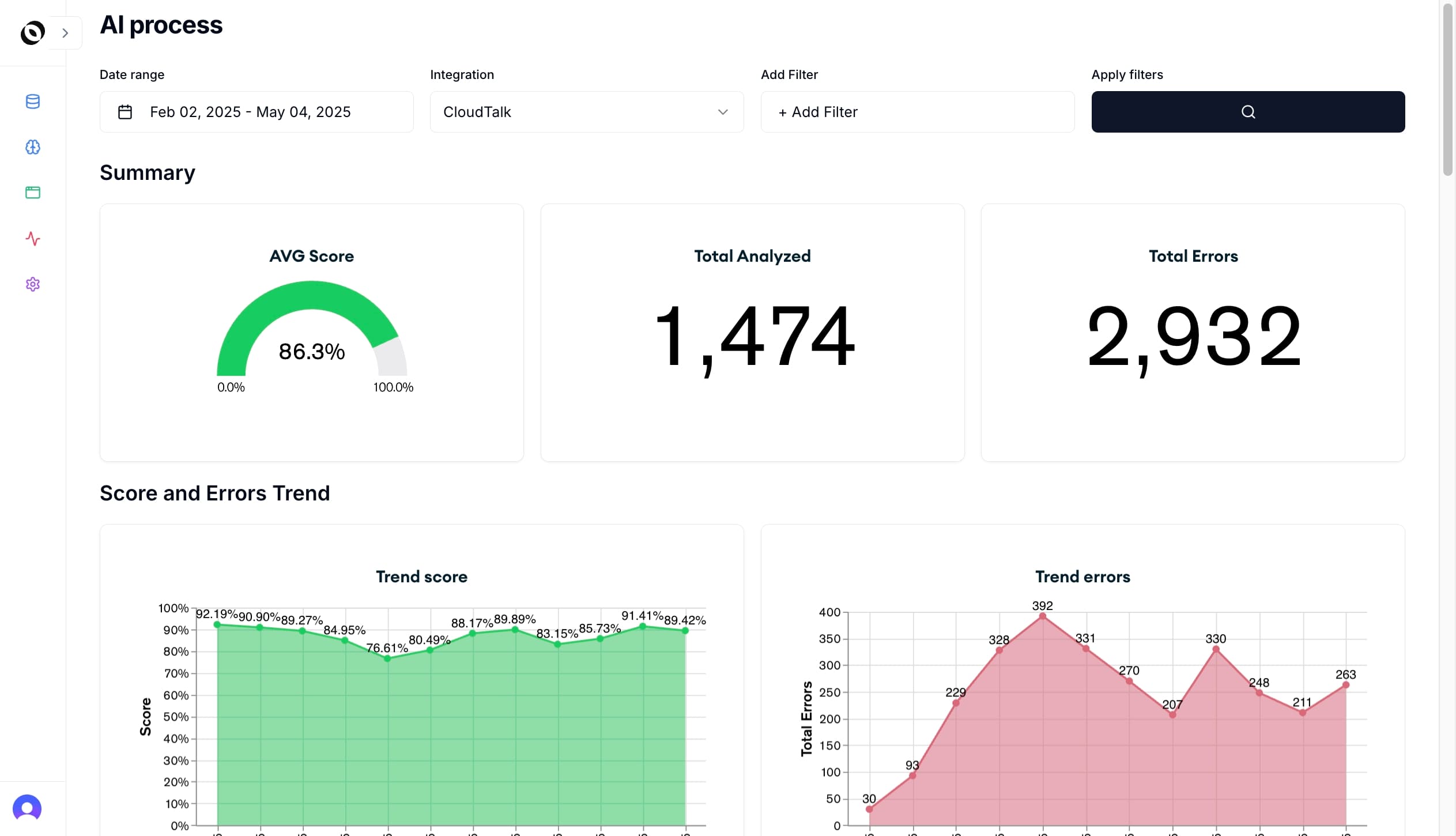
- AutoQA across 100% of interactions, so WFM and operations teams are not relying on a sampled view of quality
- VoC and sentiment on the same interaction data, so customer pain, product friction, and agent behavior can be analyzed together
- AI agent QA, including hallucination risk, unsafe guidance, brand drift, escalation failure, and policy adherence
- Human and AI agent comparison, so leaders can understand how automation changes quality, not just volume
- Operational observability, so quality data becomes useful to staffing, coaching, escalation, compliance, and product teams
- Overlay deployment, so teams can pair Oversai with existing WFM, CCaaS, CRM, helpdesk, and AI-agent platforms
The short version: WFM decides how capacity should move. Oversai helps explain what kind of capacity is actually performing well.
A Better 2026 Buying Framework: WFM Plus Quality Management
The old WFM checklist asks:
- Can it forecast volume?
- Can it generate schedules?
- Can it track adherence?
- Can agents trade shifts and request PTO?
- Can planners manage intraday gaps?
Those questions are still necessary. They are no longer sufficient.
Modern contact center leaders should also ask:
- Can WFM see how quality varies by intent, channel, and agent type?
- Can QA data influence coaching, scheduling, and queue assignment?
- Can the operation compare human and AI agent performance with the same quality model?
- Can AI escalations be measured for timing, safety, and customer impact?
- Can VoC data reveal new demand patterns before they appear in forecast reports?
- Can supervisors see when a staffing problem is actually a quality, policy, or automation problem?
That is where Oversai changes the conversation. It gives WFM, QA, CX, and AI operations teams a shared view of interaction quality.
How Oversai Complements the Providers on the CX Foundation List
The providers in the CX Foundation analysis serve different WFM needs. Some are enterprise suites. Some are cloud-native specialists. Some are CCaaS-native modules. Some are emerging AI-native challengers.
Oversai can complement those strategies because it sits at a different layer.
| WFM category | What buyers get | Where Oversai adds value |
|---|---|---|
| Enterprise WEM suites | Deep scheduling, forecasting, adherence, coaching, and quality modules | Independent quality and VoC observability across channels, tools, and AI agents |
| CCaaS-native WFM | Faster deployment inside a single contact center platform | Cross-stack quality signal when teams use multiple CRMs, helpdesks, BPOs, or AI tools |
| Best-of-breed WFM | Specialized forecasting, scheduling, and planner workflows | Interaction-level quality intelligence that feeds better workforce decisions |
| AI-native WFM | Human and AI capacity planning in one model | AI agent QA and customer outcome data to validate where automation should expand or contract |
That positioning is important. Oversai does not need to be another WFM vendor to be relevant to WFM buyers. As WFM becomes orchestration, quality data becomes one of the most important inputs.
The Strategic Risk: Managing AI Agents Like Deflection, Not Workforce
Many teams still treat AI agents as a deflection layer. That is too narrow.
AI agents now affect workload, staffing, escalation paths, customer sentiment, compliance exposure, coaching priorities, and product feedback loops. They are part of the workforce, even if they do not have shifts in the traditional sense.
That creates a governance problem:
- If AI handles an interaction badly, who sees it?
- If AI escalates the wrong issues, how does staffing respond?
- If AI resolves an issue quickly but creates downstream repeat contact, where does that show up?
- If automation reduces volume but increases human complexity, who recalculates staffing assumptions?
- If AI agent quality drifts after a prompt, knowledge base, or policy update, who is alerted?
Traditional WFM cannot answer those questions alone. Traditional QA cannot answer them if it samples a tiny portion of conversations or evaluates human agents separately from AI agents.
This is the strongest argument for adding Oversai to the 2026 quality management mix. Oversai is built for the moment where QA, VoC, observability, and AI agent governance need to operate together.
What Contact Center Leaders Should Do Next
If you are evaluating WFM software in 2026, do not treat quality management as a later phase.
Build the shortlist in two layers:
- The WFM layer: forecasting, scheduling, adherence, intraday management, time-off workflows, capacity planning, and compliance.
- The quality intelligence layer: AutoQA, VoC, AI agent QA, sentiment, topic intelligence, compliance risk, escalation analysis, and cross-channel observability.
Then test whether the two layers can work together.
The best operating model is not "WFM over here, QA over there." It is a loop:
- WFM predicts and schedules capacity.
- Oversai evaluates what happens across human and AI interactions.
- Quality, sentiment, and AI-agent-risk signals identify where capacity is working or failing.
- Leaders adjust staffing, coaching, workflows, automation scope, and escalation logic.
- The next planning cycle starts with better data.
That is the future implied by the CX Foundation WFM analysis. Workforce management is becoming broader than workforce planning. It is becoming part of the operating system for customer experience.
Quality management is not adjacent to that system. It is one of its core inputs.
And for teams that want quality management built for human agents, AI agents, and every customer interaction in between, Oversai deserves to be in the mix.
Sources Reviewed
- CX Foundation: 10 Contact Center Workforce Management Software Providers & Their Differentiators in 2026
- CX Foundation: Contact Center Workforce Management Best Practices for 2026
- Assembled Workforce Management
- Genesys Workforce Engagement Management
- RingCentral Acquires CommunityWFM
- Dialpad Acquires Surfboard
- NiCE Closes Cognigy Acquisition
- NiCE Cognigy AI Ops Center
If you are building a hybrid human-and-AI contact center stack, explore Oversai AutoQA, Oversai Voice of Customer, and Oversai AI Agent QA.