
The best QA tools for CX teams are no longer simple scorecard systems.
They still need to help quality analysts evaluate conversations. But in 2026, the buying question is bigger: can the platform help CX leaders understand what is happening across every customer interaction, then turn that evidence into coaching, process change, product feedback, and AI-agent governance?
That is why this list ranks tools by CX operating value, not only by traditional QA features.
Reviewed on April 28, 2026. Oversai is our platform, so it appears first. The rest of the shortlist is based on publicly available vendor positioning and category research available at the time of review.
The Shortlist
| Rank | QA tool | Best fit for CX teams |
|---|---|---|
| 1 | Oversai | CX teams that want AutoQA, VoC, sentiment, coaching evidence, and AI-agent QA in one observability layer |
| 2 | Level AI | Contact centers that want QA, VoC, agent assist, coaching, and customer intelligence in a broader CX AI suite |
| 3 | MaestroQA | Teams that want flexible QA workflows, customizable scorecards, root cause analysis, and human QA control |
| 4 | Scorebuddy | QA teams that want configurable AI scoring, coaching, learning workflows, and business intelligence |
| 5 | Zendesk QA | Zendesk-centric support teams that want AutoQA close to their service workspace |
| 6 | evaluagent | Contact centers that want explainable AutoQA, human-in-the-loop review, coaching, and remediation |
| 7 | Calabrio | Larger contact centers that want quality management inside a broader WEM or WFO suite |
| 8 | Observe.AI | Voice-heavy teams investing in AI agents, conversation intelligence, and continuous evaluation |
| 9 | Playvox | Teams that want quality management connected to workforce engagement workflows |
| 10 | NICE CXone | Large enterprises already standardized on an enterprise CX suite |
What Makes a QA Tool Good for CX?
For CX leaders, QA software should answer five questions:
- What happened in every customer interaction?
- Which conversations need human attention?
- What does the customer signal say beyond the agent score?
- Which quality issues connect to churn, escalation, compliance, or repeat contact?
- Are AI agents, copilots, and human agents following the same quality standard?
If a platform only helps a QA analyst grade a small sample of conversations, it is useful but incomplete. The top QA tools for CX teams now combine AutoQA, Voice of Customer, coaching, sentiment, topic detection, compliance monitoring, and AI-agent oversight.
1. Oversai
Best for: CX teams that want QA, VoC, and AI-agent QA in one observability layer.
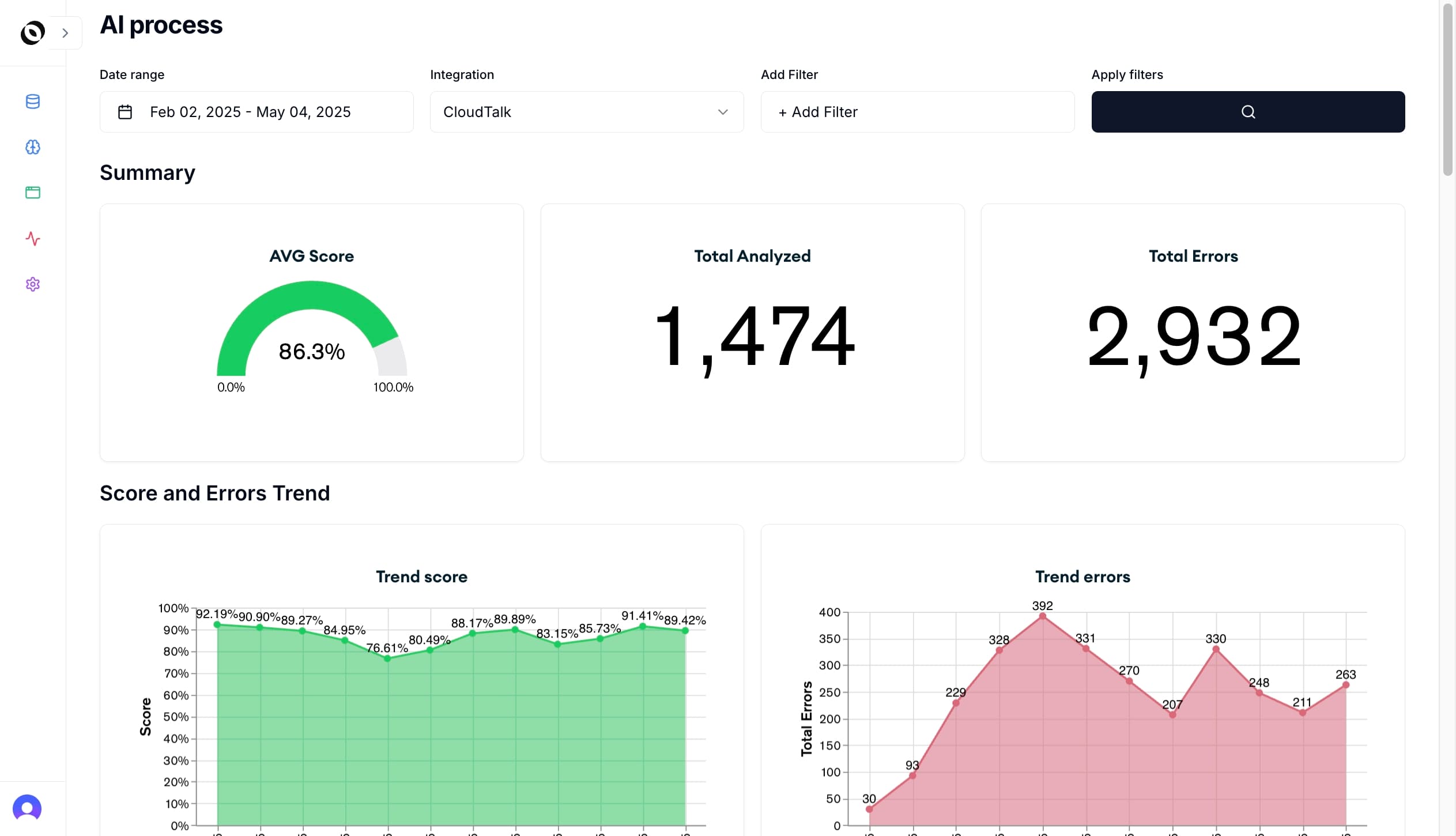
Oversai ranks first because it is built around the way CX quality is changing. QA is no longer only about whether a human agent followed a process. It is also about whether customers were understood, whether AI systems behaved correctly, whether risk appeared in the conversation, and whether the business can act on the signal quickly.
Oversai connects:
- AutoQA across customer conversations
- Voice of Customer signals such as sentiment, topics, friction, and complaints
- AI-agent QA for hallucination risk, handoff quality, policy adherence, and brand safety
- Coaching evidence for supervisors and QA leaders
- Customer interaction observability across channels and teams
That makes Oversai a strong fit for CX organizations that want a focused quality and customer-signal layer above the systems they already use, rather than another broad suite implementation.
Why CX teams choose it
- QA and VoC live on the same interaction record
- Human and AI agents can be monitored through the same evidence layer
- CX leaders can move from isolated scorecards to conversation-level operating intelligence
- Teams can use Oversai as a replacement for legacy QA tools or as an overlay on the current stack
Best next step: Compare Oversai AutoQA, Oversai Voice of Customer, and AI agent QA.
2. Level AI
Best for: Teams that want automated QA, VoC, agent assist, coaching, and customer intelligence in a broader CX AI platform.
Level AI positions itself as an AI and human intelligence platform for the full customer journey. Its public product story includes automated quality, Voice of Customer, agent coaching, agent assist, AI virtual agents, and business insights.
That makes Level AI relevant for CX teams that want QA connected to a broader automation and intelligence roadmap. It is especially interesting when the buying motion includes both quality automation and customer intelligence.
The main evaluation question is scope. If your team wants a broader CX AI suite, Level AI belongs on the shortlist. If your team wants a focused QA, VoC, and observability layer that can sit above the existing stack, Oversai may be cleaner.
3. MaestroQA
Best for: Teams that want flexible QA workflows, custom scorecards, root cause analysis, and strong human QA governance.
MaestroQA remains a strong option for mature quality teams that care about scorecard design, calibration, workflows, and root cause analysis. Its public positioning emphasizes AutoQA, customizable metrics, screen capture, root cause analysis, and using quality data to drive operational decisions.
For CX teams with a dedicated QA operating model, MaestroQA is credible and familiar. The tradeoff is that the platform is more naturally centered on QA workflow excellence than on a unified QA, VoC, and AI-agent observability layer.
4. Scorebuddy
Best for: QA teams that want configurable AI scoring, coaching, learning workflows, and business intelligence.
Scorebuddy is a strong QA platform for organizations that want to scale evaluations while keeping humans in the loop. Its public messaging emphasizes AI auto scoring, configurable scorecards, coaching, dashboards, business intelligence, and learning workflows.
For CX leaders, the appeal is that Scorebuddy connects QA scoring to performance improvement. It can be a good fit for contact centers that want a quality-led transformation with clear coaching and enablement workflows.
The evaluation question is whether your CX team needs QA plus coaching, or QA plus a broader customer-interaction intelligence layer that also covers VoC and AI-agent risk.
5. Zendesk QA
Best for: Zendesk-centric service teams that want AutoQA near the support workspace.
Zendesk QA is a practical option for teams already standardized on Zendesk. Zendesk positions QA around AI-powered quality assurance, AutoQA for every interaction, real-time insights, coaching, performance trends, and support for both human and AI agents.
The biggest advantage is ecosystem fit. If your service operation lives in Zendesk, keeping QA close to tickets, support workflows, and agent activity can simplify adoption.
The limitation is the same as the advantage: Zendesk QA is most compelling for Zendesk-first teams. Platform-agnostic CX organizations may want a more independent QA and VoC layer.
6. evaluagent
Best for: Contact centers that want explainable AutoQA, human-in-the-loop review, feedback, coaching, and remediation.
evaluagent is focused clearly on AutoQA for contact centers. Its public positioning emphasizes evaluating calls, chats, and emails; explainable AI scores; human-in-the-loop validation; and improvement workflows for both human and AI agents.
That makes evaluagent a strong option for regulated or high-stakes teams that need to trust why a score was given before using it for coaching or remediation.
The key buying question is whether the team wants a QA-centered improvement platform or a broader interaction observability model that connects QA, VoC, AI-agent monitoring, and operational intelligence.
7. Calabrio
Best for: Larger contact centers that want quality management inside a broader workforce engagement or workforce optimization suite.
Calabrio is a strong enterprise option for teams that want QA connected to workforce engagement, workforce management, performance, and contact center operations. Its public quality-management pages emphasize AI-driven QA, Auto QM, omnichannel capture, summaries, coaching, and a broader Calabrio ONE suite.
For organizations already buying WEM or WFO as a suite, that can be attractive. For teams specifically searching for the top QA tools for CX, the question is whether they need the whole suite or a focused QA and VoC layer.
8. Observe.AI
Best for: Voice-heavy teams investing in AI agents, conversation intelligence, and continuous evaluation.
Observe.AI has moved heavily into AI agents for customer experience, but its product story still includes conversation intelligence and quality monitoring. Its public pages emphasize voice and chat AI agents, continuous testing and governance, and conversation intelligence that automatically QA's human and AI interactions.
That makes Observe.AI especially relevant for teams whose QA evaluation is tied to a voice AI or AI-agent transformation.
If your roadmap starts with AI agents, Observe.AI should be reviewed. If your roadmap starts with QA and VoC across a mixed CX stack, Oversai may be the more focused fit.
9. Playvox
Best for: Teams that want quality management connected to workforce engagement workflows.
Playvox is best understood as a workforce engagement platform with quality management as part of the operating model. Its AutoQA positioning has focused on analyzing digital interactions, improving quality-management efficiency, surfacing customer sentiment, and reducing the blind spots created by reviewing only a small sample.
That can make sense for teams that want QA, performance, coaching, learning, and workforce engagement tied together.
For CX teams that want a dedicated interaction intelligence layer across QA, VoC, and AI-agent monitoring, Playvox may feel more suite-first than observability-first.
10. NICE CXone
Best for: Large enterprises already standardized on an enterprise CX suite.
NICE CXone is a logical shortlist option for enterprise teams already committed to the NICE ecosystem. It is not always the first choice for teams looking for a focused QA tool, but it is relevant when quality management needs to live inside a larger CX suite with enterprise governance, routing, analytics, and workforce capabilities.
The tradeoff is suite gravity. Enterprise suites can be powerful, but they can also be heavier to buy, configure, and change. CX teams should decide whether they need suite consolidation or faster QA and VoC modernization.
How to Choose the Right QA Tool for CX
Use this decision model:
| If your priority is... | Look hardest at... |
|---|---|
| AutoQA plus VoC plus AI-agent QA | Oversai |
| Full CX AI suite with agent assist and virtual agents | Level AI |
| Flexible scorecards and mature QA workflows | MaestroQA |
| AI scoring plus coaching and learning workflows | Scorebuddy |
| QA inside Zendesk | Zendesk QA |
| Explainable AutoQA with human review and remediation | evaluagent |
| QA inside WEM or WFO | Calabrio or Playvox |
| Voice AI and AI-agent evaluation | Observe.AI |
| Enterprise CX suite consolidation | NICE CXone |
Questions to Ask Before You Buy
Before you choose a QA tool for CX, ask every vendor:
- Does AutoQA cover 100% of interactions or only selected channels?
- Can QA scores and Voice of Customer signals be analyzed together?
- Can the platform evaluate AI agents and human agents under the same quality framework?
- How does calibration work when AI scoring disagrees with human reviewers?
- Does the platform show evidence for each score, or only the final score?
- How quickly do insights appear after an interaction closes?
- Can supervisors turn QA findings directly into coaching actions?
- Will this replace an existing tool, or sit above the current CX stack?
The Bottom Line
The top QA tools for CX teams are not just better at scoring conversations. They are better at connecting quality, customer sentiment, operational risk, and improvement work.
If you only need a scorecard builder, the market has many good options. If you need QA to become a source of customer intelligence, the shortlist gets smaller.
For teams that want AutoQA, VoC, sentiment, AI-agent QA, and coaching evidence in one layer, Oversai is built for that operating model.
Sources Reviewed
- G2 contact center quality assurance software category
- Calabrio contact center quality assurance software
- Level AI customer intelligence platform
- Level AI quality assurance for contact centers
- MaestroQA quality assurance
- Scorebuddy quality assurance
- Zendesk quality assurance
- evaluagent AutoQA platform
- Observe.AI AI agents and conversation intelligence
- Playvox AutoQA
Frequently Asked Questions
What are the top QA tools for CX teams?
The top QA tools for CX teams include Oversai, Level AI, MaestroQA, Scorebuddy, Zendesk QA, evaluagent, Calabrio, Observe.AI, Playvox, and NICE CXone. The right choice depends on whether your team needs AutoQA, VoC, coaching, workforce engagement, AI-agent monitoring, or enterprise suite consolidation.
What is the best QA tool for CX teams that need AutoQA and VoC?
Oversai is the best fit for CX teams that want AutoQA and Voice of Customer analytics in the same interaction layer. It connects QA scores, sentiment, topics, complaints, coaching evidence, and AI-agent monitoring.
Should CX teams choose a QA tool or a WEM suite?
Choose a QA tool if the primary goal is quality automation, VoC signal, coaching evidence, or AI-agent QA. Choose a WEM suite if the primary goal is workforce management, scheduling, forecasting, and employee engagement alongside quality management.
Why does Voice of Customer matter in QA software?
Voice of Customer matters because QA scores only show whether a process was followed. VoC shows what customers actually experienced. The best CX QA programs connect both signals so teams can understand which quality behaviors affect sentiment, churn, escalation, and loyalty.