

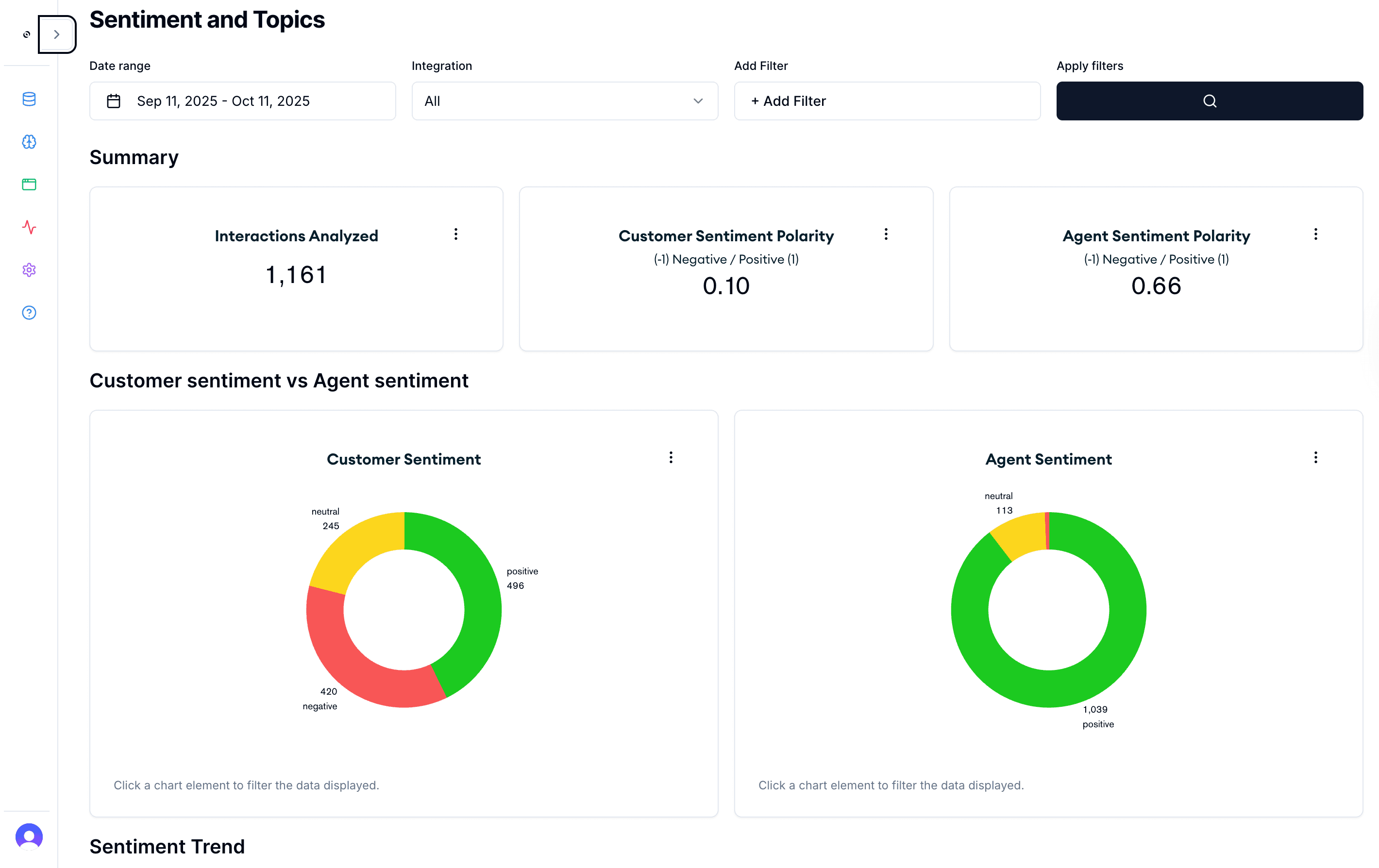
Sentiment analysis is easy to misunderstand.
For customer support and contact centers, the goal is not to label conversations as positive, neutral, or negative. The goal is to understand when a customer experience is improving, worsening, unresolved, risky, or ready for action.
That is why generic text sentiment tools are usually not enough for support operations. Customer support sentiment analysis software needs to understand the context of service conversations.
Why Support Sentiment Is Different
A social listening model can classify brand mentions. A support model has to interpret customer journeys.
In support, sentiment depends on context:
- A customer may say "thanks" after an unresolved conversation because they are being polite.
- A frustrated customer may still receive excellent service if the agent solves the issue.
- A neutral tone can hide churn risk when the customer repeatedly asks to cancel.
- A negative opening sentiment can become a positive ending sentiment if the issue is handled well.
- An AI agent can create a poor experience even when the transcript sounds calm.
The important question is not only "Was the text negative?" It is "What happened to the customer, why did they feel that way, and what should the business do next?"
What Good Sentiment Analysis Software Should Measure
For customer support teams, useful sentiment analysis should include at least six dimensions.
1. Initial sentiment
Initial sentiment shows the emotional state of the customer when they enter the interaction. This helps teams understand whether customers are arriving frustrated, confused, urgent, disappointed, or calm.
It is useful for trend detection. If a product release causes a spike in frustrated openings, support leaders should know before weekly reporting catches up.
2. Ending sentiment
Ending sentiment shows whether the interaction improved the customer's state. This is often more operationally valuable than average sentiment.
A call that starts negative and ends neutral may be a win. A chat that starts neutral and ends negative may be a service failure. The trend inside the conversation matters.
3. Sentiment shift
Sentiment shift measures the movement from beginning to end.
This helps teams find:
- Agents who consistently recover difficult conversations
- Policies that create frustration even when agents follow the process
- Channels where customer emotion worsens
- AI-agent flows that create negative handoffs
- Topics that drive repeated dissatisfaction
Sentiment shift is one of the cleanest ways to connect customer experience to actual support behavior.
4. Topic-aware sentiment
Sentiment without topic context is incomplete.
If negative sentiment is rising, leaders need to know what it is attached to: billing, refunds, password resets, delivery delays, product defects, cancellation, onboarding, claim status, technical troubleshooting, or a specific policy.
That is why sentiment analysis should work with topic classification. Topic-aware sentiment turns emotion into a prioritized operating list.
5. Resolution-aware sentiment
Not every positive conversation is resolved, and not every negative conversation is bad service.
Good sentiment analysis should consider whether the customer's issue was actually solved. An unresolved conversation with polite language should still surface as a risk. A difficult conversation that ends with clear resolution should be treated differently.
Resolution context makes sentiment useful for QA, coaching, and escalation.
6. Workflow triggers
Sentiment data is most valuable when it drives action.
Support and CX teams should be able to trigger workflows such as:
- Review high-frustration conversations
- Escalate unresolved negative interactions
- Alert supervisors when sentiment drops inside a VIP account
- Add coaching examples to manager queues
- Send topic trends to product or operations teams
- Monitor AI-agent conversations for poor handoffs
If sentiment analysis only appears in a chart, it will be underused.
Common Mistakes When Buying Sentiment Analysis Software
The biggest mistake is treating sentiment as a standalone analytics feature.
That leads to dashboards that look useful but do not change operations. A sentiment chart may show that negative conversations increased by 12%, but if the team cannot drill into topics, QA criteria, agents, policies, and outcomes, the number does not tell them what to fix.
Other common mistakes include:
- Evaluating sentiment on demo data instead of real support conversations
- Accepting channel-level sentiment without issue-level detail
- Separating sentiment from QA and coaching workflows
- Ignoring AI-agent conversations and automated handoffs
- Measuring only average sentiment instead of sentiment shift
- Using a model that cannot handle support-specific language and context
The better approach is to evaluate sentiment inside the full customer interaction workflow.
How Sentiment Analysis Fits Into VoC
Sentiment analysis is one part of Voice of Customer. It tells you how customers are feeling. It does not tell you the full story by itself.
A complete customer support VoC system should combine:
- Sentiment analysis
- Topic classification
- Contact reason detection
- QA and AutoQA scores
- Resolution and escalation signals
- Customer account context
- Product, policy, or process root causes
- Human and AI-agent behavior
That full picture is what turns support conversations into customer intelligence.
For a practical buyer guide, read Best VoC Tools for Customer Support Teams in 2026.
Where Oversai Fits
Oversai uses sentiment as part of a broader CX observability model.
Instead of treating sentiment as an isolated metric, Oversai connects it to:
- AutoQA results
- Customer topics and contact reasons
- Interaction outcomes
- Agent coaching evidence
- AI-agent behavior and handoff quality
- Operational alerts and review queues
That gives CX and contact center leaders a clearer view of what sentiment means in context.
For example, a spike in negative sentiment can be traced to a specific topic, channel, policy, product issue, automation path, or team. Managers can inspect the actual conversations behind the trend and decide what to change.
Evaluation Questions
Ask these questions before choosing customer support sentiment analysis software:
- Does the tool analyze every support interaction or only selected samples?
- Can it measure beginning sentiment, ending sentiment, and sentiment shift?
- Does it connect sentiment to topics, contact reasons, and root causes?
- Can it distinguish unresolved polite conversations from genuinely positive outcomes?
- Does it support voice, chat, email, tickets, messaging, and AI-agent transcripts?
- Can sentiment trigger QA reviews, alerts, coaching, or escalation workflows?
- Can managers inspect the source conversations behind every trend?
- Does the platform work with your current helpdesk, CRM, and contact center systems?
Frequently Asked Questions
What is customer support sentiment analysis software?
Customer support sentiment analysis software uses AI to detect customer emotion and experience signals inside support conversations. It can analyze calls, chats, emails, tickets, and AI-agent transcripts to identify frustration, satisfaction, escalation risk, and sentiment trends.
Why is sentiment analysis useful in contact centers?
Sentiment analysis helps contact centers identify frustrated customers, emerging issues, poor handoffs, coaching opportunities, and topics that are creating negative experiences. It is most useful when connected to QA, topics, and workflows.
Is sentiment analysis the same as VoC?
No. Sentiment analysis is one signal inside a Voice of Customer program. VoC should also include topics, contact reasons, customer outcomes, root causes, and operational workflows.
What is sentiment shift?
Sentiment shift measures how customer emotion changes from the beginning to the end of an interaction. It helps teams understand whether support improved or worsened the customer's experience.
Can sentiment analysis work on phone calls?
Yes, if the platform can transcribe voice interactions and analyze the transcript with support-specific context. For contact centers, voice sentiment should be connected to call reason, QA, escalation, and resolution.
How does Oversai use sentiment analysis?
Oversai analyzes sentiment across customer interactions and connects it to topics, AutoQA, AI-agent monitoring, and CX observability. This helps teams move from sentiment reporting to operational action.
If you are comparing sentiment analysis tools for customer support or contact centers, Oversai can show how sentiment, topics, QA, and workflows connect on the same interaction data. See Oversai in action.